Execution vs Intuition at the Beginning of the Year
The beginning of the year triggers a psychological shift in how traders approach their methodologies. The calendar reset creates a sense of renewal that often manifests as increased conviction in intuitive judgment. Traders who followed systematic rules in December begin trusting their instincts in January, believing that renewed focus and commitment will improve outcomes.
This shift from execution to intuition is subtle but destructive. It replaces disciplined adherence to documented rules with case-by-case interpretation based on conviction. The trader believes they are applying judgment. In reality, they are abandoning the execution framework that their strategy requires. Every override driven by conviction rather than criteria adds to what we call execution leak — the gap between planned trades and actual behavior.
Why Conviction Increases in January
New Year's resolutions create a mindset of self-improvement and renewed capability. Traders enter January with heightened confidence in their ability to make better decisions. This confidence extends to trading, where it manifests as trust in intuitive judgment over systematic execution.
The trader who followed entry rules mechanically in November now believes they can identify which setups are truly high-probability versus those that merely meet technical criteria. The trader who applied exit rules consistently in December now trusts their ability to sense when a position requires more room or when risk should be reduced ahead of schedule.
This conviction feels like improvement. The trader believes they are adding valuable judgment to their execution. But conviction is not the same as accuracy. The trader has not developed new analytical capabilities in the two weeks since December. They have simply developed increased confidence in their intuition, which is unrelated to the actual quality of that intuition.
How Intuition Undermines Systematic Execution
Systematic execution requires that the same conditions always produce the same response. An entry signal that meets documented criteria results in position initiation. An exit trigger that occurs results in position closure. The system does not differentiate between setups that feel strong and setups that feel marginal. It executes based on criteria, not conviction.
When a trader begins applying intuition to execution, this consistency breaks down. Some entry signals are taken because they align with the trader's conviction. Others are passed because the trader senses weakness despite meeting all technical criteria. Some exits are honored because the trader agrees with the signal. Others are delayed because the trader believes the position has more potential.
The result is that the trader is no longer executing their documented methodology. They are executing a hybrid approach where intuition overrides systematic rules whenever conviction is sufficiently strong. This hybrid approach has never been tested. It is pure execution leak — undocumented deviations that cannot be evaluated or refined. It has no documented criteria. It cannot be evaluated or refined because it exists only as a collection of intuitive judgments applied inconsistently across different market conditions.
The New Year's Resolution Effect
New Year's resolutions compound this problem by creating explicit commitments to trust intuition more, be more selective, or apply more judgment to execution. These resolutions feel like discipline improvements. In practice, they are commitments to abandon systematic execution in favor of discretionary interpretation.
A trader who resolves to be more selective with entries is committing to override their entry criteria based on subjective assessment. A trader who resolves to trust their instincts more is committing to replace systematic rules with intuitive judgment. A trader who resolves to take only the highest-conviction setups is committing to fragment their execution based on internal confidence levels that have no correlation with actual outcomes.
These resolutions feel intentional and disciplined. They introduce execution variability that was not present when the trader was simply following their documented methodology without second-guessing each signal.
Why Intuition Fails as an Execution Framework
Intuition cannot serve as an execution framework because it is not consistent across time or conditions. What feels like a high-conviction setup in one market environment may feel marginal in another, even when the technical criteria are identical. What triggers a strong intuitive exit signal during a drawdown may not trigger the same response during a winning streak.
The trader using intuition cannot evaluate whether their methodology is sound because they are not executing a defined methodology. They are applying judgment that changes based on psychological state, recent outcomes, and market conditions. This variability makes it impossible to distinguish between strategy weaknesses and execution inconsistency.
Systematic execution eliminates this ambiguity. The methodology defines what constitutes an entry, an exit, and a position size adjustment. These definitions do not change based on the trader's conviction level or the time of year. They execute identically in January as they did in November, which allows accurate evaluation of whether the methodology itself requires refinement.
How Deterministic Systems Prevent Intuition Drift
Deterministic systems do not experience increased conviction in January. The execution logic remains constant regardless of calendar transitions or the trader's psychological state. If an entry condition is met, the position is initiated. If an exit condition is met, the position is closed. The system does not apply intuition to determine whether a signal is high-conviction or marginal.
This consistency is what preserves execution discipline across seasonal transitions. The trader using a deterministic system cannot override signals based on conviction because the system executes automatically. The New Year's resolution to trust intuition more has no impact on execution because intuition is not part of the execution process.
This does not mean intuition has no role in trading. Intuition can inform strategy development, parameter selection, and risk management frameworks. But these decisions occur outside of real-time execution. Once the strategy is defined, execution follows the documented logic without interpretation or intuitive adjustment.
The Cost of Replacing Execution with Conviction
Traders who shift from execution to intuition in January create a pattern that persists throughout the year. The initial conviction gradually erodes as the year progresses. By March, the trader is no longer certain which signals warrant intuitive override and which should be followed systematically. By June, the trader has abandoned both the systematic framework and the intuitive approach, defaulting to inconsistent execution driven by recent results and emotional state.
This degradation is not visible in January when conviction is high. It becomes visible over time when the trader realizes they have spent months executing inconsistently without a clear framework to guide decisions. The systematic methodology they started with has been replaced by ad hoc judgment that varies based on conditions they cannot articulate or reproduce.
Deterministic systems avoid this degradation by maintaining execution consistency regardless of conviction levels or calendar transitions. The system executes the defined methodology in January, March, and June with identical logic. This continuity is what allows discipline to persist across the full year rather than fragmenting after the initial resolution-driven conviction fades.
Structure Over Conviction
Execution beats intuition at the beginning of the year because execution maintains consistency while intuition introduces variability. New Year's resolutions that encourage trusting conviction more or being more selective fragment systematic execution by replacing documented criteria with subjective judgment. This shift feels like improvement but results in execution inconsistency that compounds over time.
Deterministic systems enforce execution discipline by removing the option to override signals based on conviction. The system does not experience increased confidence in January. It executes the same logic it executed in December, preserving the consistency required for long-term discipline development.
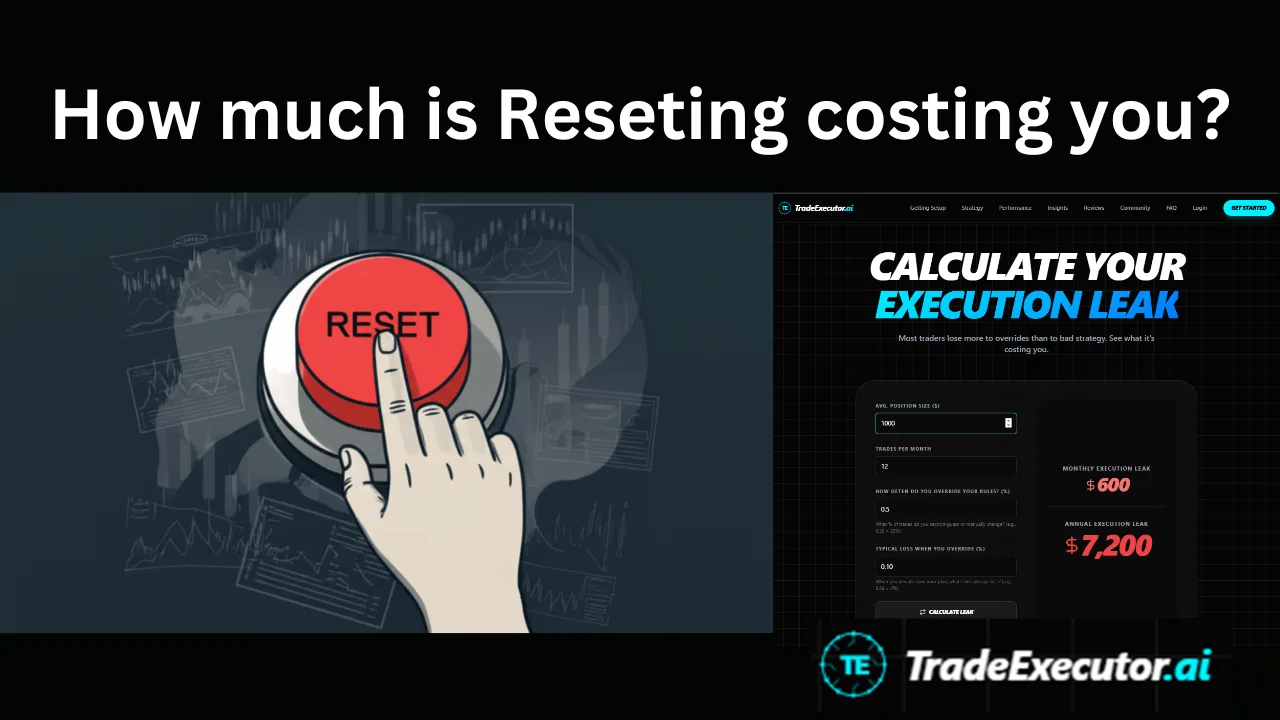
This is the structural difference that separates systematic execution from conviction-driven discretion. Execution produces repeatable results that can be evaluated and refined. Conviction produces variability that obscures whether outcomes are driven by the methodology or by inconsistent application. The traders who maintain execution discipline build systematic approaches that compound over time. The traders who trust conviction rebuild their framework every January and wonder why consistency remains elusive. Addressing your execution leak starts with measuring it.
How much is your execution leak costing you?
Most traders lose more to overrides than to bad strategy. Calculate yours in 30 seconds.
Calculate Your LeakRelated Reading
TradeExecutor.ai — deterministic automated execution engine
← Back to Insights