What Earnings Season Reveals About Trading Structure
Earnings season introduces a predictable pattern of elevated volatility, information asymmetry, and event-driven price action. These conditions create execution challenges that reveal whether a trader's methodology is structurally sound or dependent on stable market behavior. The same execution framework that functioned adequately between reporting cycles often fragments when earnings announcements cluster.
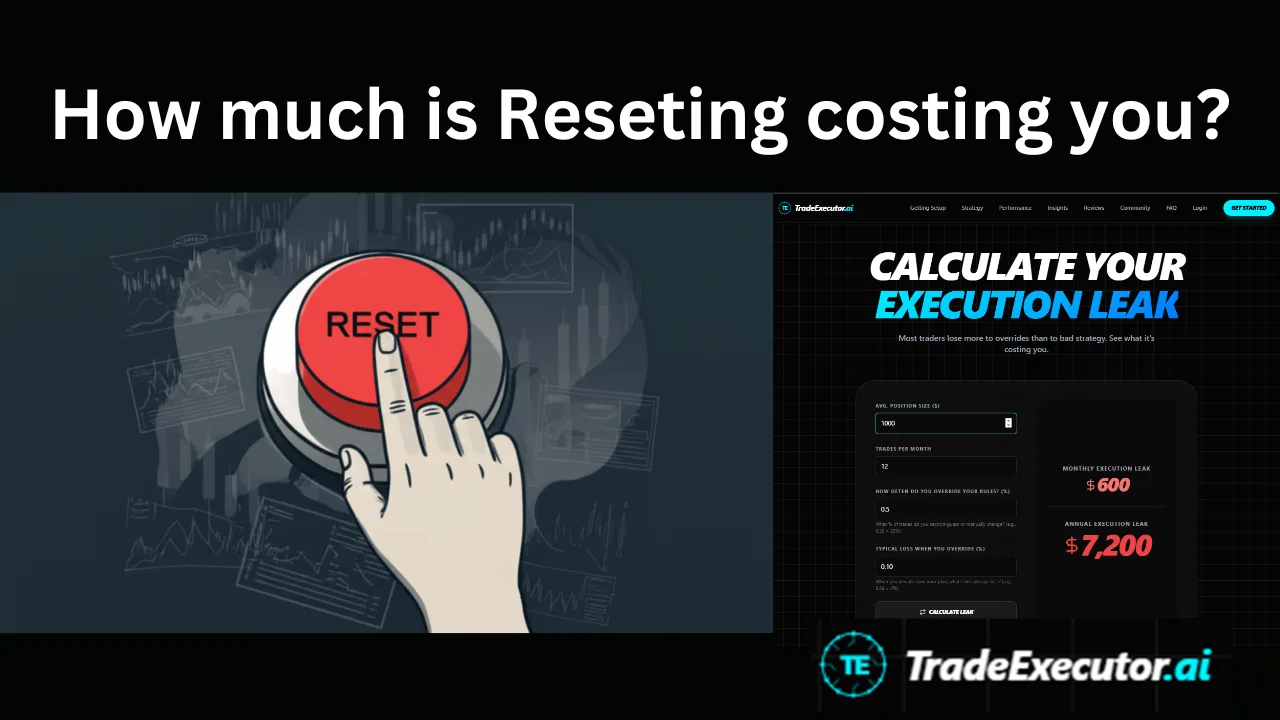
This is not about predicting earnings outcomes or capitalizing on post-announcement moves. This is about whether execution discipline remains consistent when market conditions shift from gradual trend development to discrete event-driven catalysts. Earnings season does not create execution problems. It reveals which traders have built frameworks that maintain discipline across varying information environments. The execution leak — the gap between your documented rules and your actual behavior — becomes visible when event-driven conditions test your discipline.
For more on this topic, see Why Deterministic Systems Handle New Market Regimes Better.
Why Earnings Season Challenges Execution Discipline
Between earnings cycles, price action is primarily driven by technical patterns, sector rotation, and macroeconomic data. Execution rules designed for these conditions assume gradual information flow and continuous price discovery. Entry signals develop over hours or days. Exit conditions trigger based on technical invalidation or profit targets.
Earnings season compresses information flow into discrete events. A position that met all entry criteria can gap against the trader overnight. A technical pattern that appeared valid becomes irrelevant when fundamental data shifts the underlying thesis. The execution framework that assumed continuous price discovery now faces binary outcomes and discontinuous price changes.
Discretionary traders respond by adjusting their execution. They avoid initiating positions before known events. They exit positions ahead of announcements to eliminate gap risk. They wait for post-earnings volatility to subside before resuming normal execution. Each adjustment feels prudent given the elevated event risk.
But these adjustments reveal that the trader's execution framework was never designed to handle predictable periods of information asymmetry. They had rules for normal conditions and are now improvising rules for earnings season. The methodology fragments into two separate execution modes with undefined transition points between them.
The Structural Flaw of Event-Conditional Execution
Traders who modify their execution during earnings season create event-conditional logic. Normal execution rules apply outside of reporting cycles. Modified rules apply during earnings windows. The transition between these rule sets requires judgment about when earnings risk becomes material enough to trigger the modified approach.
This introduces three layers of discretion. First, determining which upcoming events warrant execution modification. Second, deciding when to shift from normal to event-conditional rules. Third, interpreting how long after an event the event-conditional rules should remain in effect. Each layer creates execution variability that was not present in the original methodology.
The trader believes they are managing risk. In practice, they are fragmenting their execution framework into multiple modes, none of which were systematically tested. This is execution leak accumulating across every earnings cycle. The rules that govern earnings season differ from the rules that govern other periods, but these earnings-specific rules exist only as ad hoc adjustments rather than as a deliberately designed component of the strategy.
Why Position Management Breaks Down
Earnings season particularly exposes weaknesses in position management logic. A trader who follows systematic exit rules between reporting cycles often abandons those rules when events approach. A position showing a technical exit signal might be held through earnings because the trader believes the event could validate the thesis. A position showing continuation patterns might be exited prematurely to avoid event risk.
This selective application of exit rules eliminates the consistency required for meaningful evaluation. Some positions are exited based on technical criteria. Others are exited based on calendar proximity to events. The methodology no longer defines when positions should be closed. The trader's judgment about event risk defines when positions should be closed.
Over time, this pattern trains the trader to override their documented exit rules whenever an upcoming event creates uncertainty. Earnings season occurs quarterly, which means this override pattern repeats every three months. The trader never develops the discipline to follow exit rules consistently because they regularly practice abandoning those rules in favor of event-driven discretion.
How Deterministic Systems Handle Earnings Cycles
Deterministic systems do not shift between normal and event-conditional execution modes. The logic that governs position initiation and closure remains constant whether earnings are scheduled for tomorrow or three months from now. If a position meets entry criteria, it is initiated. If it meets exit criteria, it is closed. The presence of an upcoming event does not modify these criteria.
This does not mean deterministic systems ignore earnings. Event risk can be incorporated into the strategy design. Position sizing can be reduced for holdings with imminent announcements. Entry filters can exclude positions within defined windows of scheduled events. Stop distances can be widened to accommodate expected volatility. But these adjustments are part of the defined methodology, not discretionary modifications applied during execution.
The critical difference is that the execution logic is consistent. A position initiated on Monday follows the same exit rules whether earnings are scheduled for Tuesday or for next quarter. The system does not apply different logic based on the trader's assessment of event proximity or materiality. It executes the defined rules uniformly across all calendar periods.
What Consistent Execution During Earnings Reveals
Maintaining execution consistency during earnings season reveals whether a strategy is structurally sound or merely functional during favorable conditions. A strategy that only works when earnings risk is distant is not a complete strategy. It is a partial strategy that requires discretionary intervention during predictable periods of elevated event risk.
Deterministic systems expose this limitation during development. If the strategy cannot handle earnings-adjacent positions systematically, that becomes apparent when defining the execution logic. The trader must either design event-handling rules into the strategy or accept that the strategy will experience periodic drawdowns during reporting cycles. Both options are deliberate choices made during strategy development rather than improvised responses during live execution.
Discretionary traders discover this limitation during live execution, often repeatedly across multiple earnings seasons. Each quarter, they recognize that their normal execution rules do not accommodate event risk well. Each quarter, they improvise adjustments. Each quarter, they fail to convert those improvised adjustments into systematic refinements that could be tested and validated.
The Compounding Effect of Quarterly Fragmentation
Earnings season occurs four times per year. Each cycle introduces a period during which the trader modifies their execution approach. Over multiple years, this creates a pattern where the trader is executing their documented methodology only during the intervals between reporting cycles. One third of trading days occur within earnings season windows. The trader spends one third of their time executing modified rules that were never formally defined.
This fragmentation prevents the development of consistent execution discipline. The trader is perpetually switching between normal execution and event-conditional execution, which means they never fully automate either approach. The mental effort required to decide when to apply which rule set consumes attention that could be directed toward strategy refinement and risk management.
Deterministic systems eliminate this fragmentation by maintaining consistent execution across earnings cycles. The same logic applies in January, April, July, and October. If earnings create challenges, those challenges affect all relevant positions uniformly, which preserves the ability to evaluate whether the strategy requires systematic refinement. The execution framework does not fragment quarterly based on reporting calendars.
Structure Over Event-Driven Adaptation
Earnings season reveals whether a trading structure is complete or conditional. Complete structures maintain execution consistency across reporting cycles because event risk is incorporated into the strategy design. Conditional structures fragment during earnings season because they rely on discretionary adjustments to handle predictable information events.
Discretionary traders treat earnings season as an exception requiring modified execution. Deterministic traders treat earnings season as a recurring condition their strategy must handle systematically. This difference in perspective leads to different structural outcomes. One produces quarterly fragmentation. The other produces consistent execution that can be evaluated and refined across all market conditions.
This is the structural difference that separates systematic execution from event-conditional discretion. Execution matters more during reporting cycles because reporting cycles expose whether the methodology is designed to function across all conditions or only during intervals between events. Earnings season does not test strategy quality. It tests structural completeness. Addressing your execution leak starts with measuring it. The traders who maintain execution consistency reveal they have built complete frameworks. The traders who fragment their execution reveal they have built conditional frameworks that break down during predictable periods of elevated event risk.
How much is your execution leak costing you?
Most traders lose more to overrides than to bad strategy. Calculate yours in 30 seconds.
Calculate Your LeakRelated Reading
TradeExecutor.ai — deterministic automated execution engine
← Back to Insights