Why Trading Systems Break During Earnings
Earnings announcements represent scheduled information events with predictable timing and unpredictable outcomes. Most discretionary trading systems are designed around continuous price discovery rather than discrete information releases. When earnings approach, these systems encounter execution conditions they were not structured to handle. The result is not simply reduced effectiveness but systematic breakdown of the execution framework itself.
This breakdown occurs because earnings create a specific combination of pressures that expose structural weaknesses in discretionary execution. Gap risk, compressed decision windows, and conflicting signals all emerge simultaneously. The trader must navigate these pressures while maintaining adherence to a methodology that was not designed with these conditions in mind. Under this stress, execution discipline fragments predictably.
For more on this topic, see What Earnings Season Reveals About Trading Structure.
The Pre-Announcement Position Dilemma
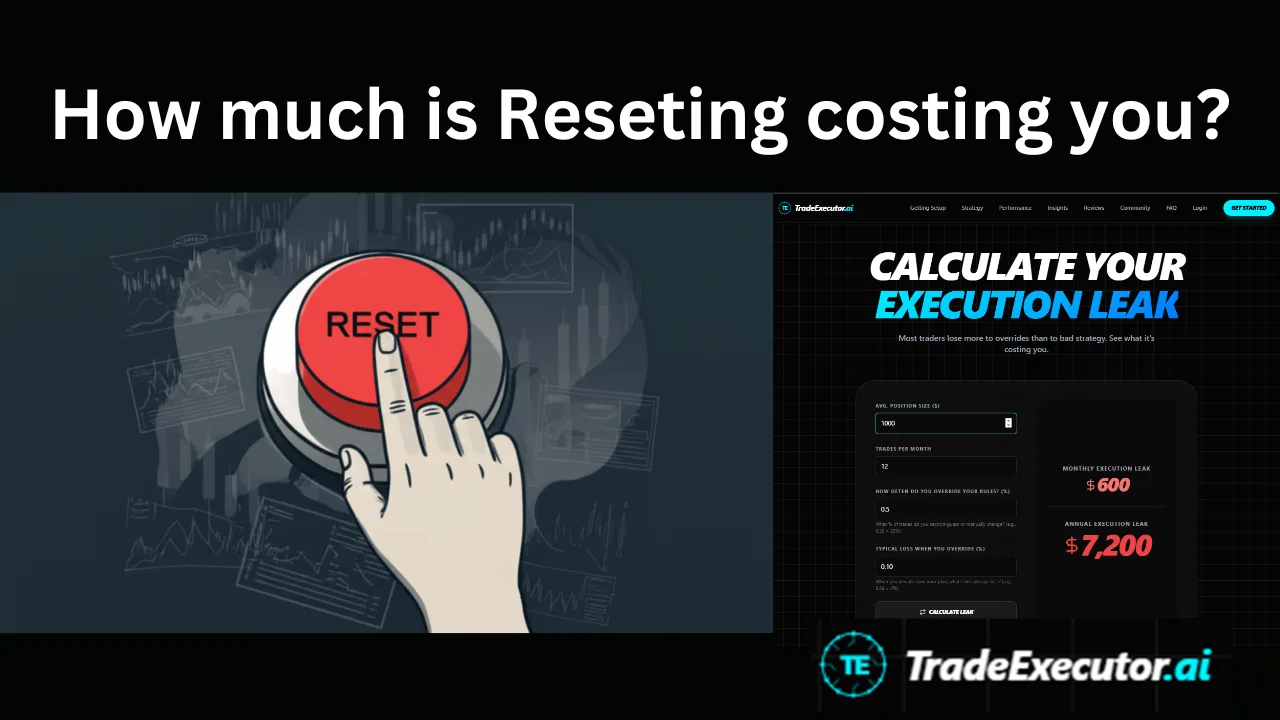
The most common execution error during earnings occurs in the days before an announcement. A position that met all entry criteria and shows technical continuation patterns now faces a binary event that could gap price substantially in either direction. The trader must decide whether to maintain the position through the announcement or exit before the event to avoid gap risk — a pattern we call execution leak, the measurable gap between planned trades and actual behavior.
Neither option aligns cleanly with the documented methodology. The methodology defines exit conditions based on technical invalidation or profit targets, not based on calendar proximity to scheduled events. But the methodology also contains no explicit guidance for handling overnight gap risk, which means the trader is making an undocumented judgment call about whether event risk supersedes documented exit logic.
Most traders choose to exit positions before earnings regardless of whether technical exit conditions have been met. This feels prudent because it eliminates gap risk. But it introduces execution inconsistency. The trader is overriding their exit rules based on a criterion that exists nowhere in their documented methodology. The system is breaking down not because the market is behaving unusually but because the trader is applying undocumented logic to handle a predictable condition.
Why Post-Announcement Entries Create Confusion
After earnings are announced, price often gaps significantly and then continues moving in the gap direction or reverses. Technical patterns that appeared valid before the announcement may no longer exist after the gap. New patterns may form in the immediate post-announcement volatility. The trader faces questions their methodology does not answer: Should gap moves be traded the same way as continuous moves? Do the same entry criteria apply to post-announcement setups?
These questions reveal a structural gap in the methodology. The system was designed assuming price discovery occurs continuously. Earnings create discontinuous price changes that violate this assumption. The trader now must improvise answers to questions about whether their entry rules apply to gaps, whether post-announcement volatility requires wider stops, and whether the first hour after an announcement should be avoided entirely.
Each improvised answer represents a deviation from the documented system. The trader is building event-specific logic in real time without testing or validation. By the end of earnings season, the trader has accumulated dozens of these improvised modifications, none of which were part of the original methodology and all of which introduce execution variability.
The Gap Risk Rationalization Pattern
Gap risk creates a rationalization pattern that compounds across earnings cycles. The trader exits a position before earnings to avoid gap risk. The stock gaps favorably, validating the trader's thesis but occurring outside their position. The trader concludes they made the wrong decision by exiting. Next earnings cycle, they maintain the position through the announcement. The stock gaps unfavorably, creating a loss larger than their documented risk parameters allow. The trader concludes they should have exited.
This alternating pattern produces no learning because each outcome is driven by unknowable information rather than by execution quality. The trader who exited before a favorable gap cannot know whether that gap would have occurred. The trader who held through an unfavorable gap cannot know whether exiting would have been better. The only consistent pattern is that the trader's execution differs from their documented methodology whenever earnings approach.
Over multiple earnings cycles, this pattern trains the trader to mistrust their own exit rules. The rules worked between earnings but failed during earnings, which creates the perception that the rules are context-dependent rather than universal. The trader begins applying judgment about when rules apply and when they should be overridden. The methodology fragments into normal-execution mode and earnings-execution mode, with the transition between modes governed by subjective assessment rather than defined criteria.
How Deterministic Systems Handle Earnings Systematically
Deterministic systems address earnings through explicit event-handling logic built into the strategy design. The system defines in advance how positions should be managed when scheduled events approach. This might mean automatic position closure within a defined window before announcements. It might mean position size reduction for holdings with imminent events. It might mean no special handling, accepting gap risk as a cost of maintaining execution consistency.
The critical difference is that these decisions are made during strategy development, not during live execution. The trader decides once how the system should handle earnings, encodes that decision into the execution logic, and the system applies that logic uniformly across all earnings events. There is no improvisation. There is no case-by-case evaluation of whether this particular earnings announcement warrants special treatment.
If the earnings-handling logic produces poor outcomes, that becomes visible systematically. The trader can evaluate whether the approach to earnings needs refinement and can test alternative approaches before implementing changes. The methodology either includes earnings-handling logic or it does not. If it does not, earnings are treated identically to any other day. If it does, the handling logic is applied consistently rather than selectively.
Common Execution Errors Under Event Pressure
Earnings pressure produces predictable execution errors that appear across different traders and different methodologies. The first error is premature position closure based on event proximity rather than technical invalidation. The second error is delayed re-entry after events because the trader is uncertain whether post-announcement patterns qualify as valid setups. The third error is widened stops on positions held through announcements, which violates documented risk management but feels necessary given gap risk.
Each error represents the same structural problem: the methodology provides no guidance for handling discrete information events. The trader improvises solutions that feel reasonable but introduce execution variability. These improvisations are not tested. They are not documented. They are applied inconsistently based on the trader's current conviction about event risk. The execution framework breaks down not catastrophically but incrementally, fragmenting into documented rules that apply most of the time and undocumented rules that apply during events.
A fourth error emerges over time: earnings avoidance. The trader recognizes that their execution becomes inconsistent during earnings season and responds by reducing activity during these periods. This eliminates the execution errors but at the cost of systematic underperformance during one third of the calendar. The methodology has fractured into active periods and passive periods, with the passive periods defined by the trader's discomfort with event-driven execution rather than by market conditions that invalidate the strategy.
Why Systematic Event Handling Requires Advance Design
Event handling cannot be improvised during live execution because events create time pressure and emotional intensity that impair decision quality. The trader facing an earnings announcement tomorrow must decide now whether to exit a winning position. The decision must be made with incomplete information under psychological pressure to avoid potential regret regardless of which choice is made.
This is precisely when discretionary judgment produces the lowest quality decisions. The trader is optimizing for immediate emotional comfort rather than for long-term execution consistency. Exit before the event and avoid gap risk discomfort. Hold through the event and avoid missing-move regret. Neither decision is grounded in systematic analysis of whether the approach improves outcomes across multiple events.
Deterministic systems move this decision to strategy development where it can be made without time pressure or emotional load. The trader decides once, systematically, how earnings should be handled. That decision is encoded into execution logic that applies uniformly. When the next earnings announcement approaches, no decision is required. The system executes the predetermined logic regardless of whether this particular event feels more or less risky than previous events.
Structure Over Improvisation
Trading systems break during earnings because earnings expose structural gaps in discretionary execution frameworks. The methodology provides no guidance for handling discrete information events. The trader improvises solutions under time pressure and emotional stress. These improvised solutions introduce execution variability that compounds across earnings cycles. Eventually the trader recognizes the pattern and responds by avoiding earnings entirely, which creates systematic underperformance during predictable calendar periods.
Deterministic systems avoid this breakdown by incorporating event handling into the strategy design. The system defines in advance how earnings should be managed. That definition is applied uniformly without improvisation or selective application. If the approach produces poor outcomes, the system can be refined systematically rather than abandoned during event periods.
This is the structural difference that separates systematic event handling from discretionary improvisation. One requires the trader to make good decisions under the worst possible conditions. The other allows the trader to make decisions once, deliberately, during strategy development. Common execution errors during earnings are not failures of judgment. They are the inevitable result of applying discretionary execution to event-driven conditions that discretionary frameworks are not structured to handle. The systems that break during earnings are the systems that were incomplete from the beginning. Addressing your execution leak starts with measuring it.
How much is your execution leak costing you?
Most traders lose more to overrides than to bad strategy. Calculate yours in 30 seconds.
Calculate Your LeakRelated Reading
TradeExecutor.ai — deterministic automated execution engine
← Back to Insights