Why Traders Fail to Follow Their Own Trading Plan
You wrote the plan when the market was closed, your P&L was neutral, and your thinking was clear. You violated the plan three sessions later under conditions that felt completely different. This is not a discipline failure. It is a design failure. The trading plan assumes it will be executed by the same cognitive state that wrote it. Live markets guarantee that assumption is never true.
Most traders fail to follow their plan for a reason they rarely diagnose correctly. They believe the problem is willpower — that if they were more disciplined, more focused, more committed, they would execute perfectly. They review their losses, recommit to the rules, and return to the market with renewed resolve. Within days, sometimes hours, the same pattern repeats. The problem was never commitment. The problem is that the human brain is not designed to be a consistent execution engine under financial risk.
Research on decision fatigue, loss aversion, and cognitive load consistently shows that real-time judgment degrades when stakes are high and outcomes are immediate. Writing a trading plan is an analytical task. Following it in real time is an emotional task. These engage different cognitive systems, and the emotional system wins when pressure escalates. Traders are not weak for failing to follow their plans. They are human, and human cognition is structurally incompatible with consistent mechanical execution.
The Three Patterns Behind Every Deviation
Traders who fail to follow their plan almost always do so in one of three predictable patterns. Recognizing the pattern does not fix it — but it clarifies why willpower-based solutions consistently fail.
Pattern one: the hesitation trade. The setup forms exactly as planned. Everything qualifies. The trader pauses. Doubt surfaces. The conditions look right on paper, but something feels off. Maybe the broader market is weak. Maybe this particular symbol has been erratic. Maybe the trader had a loss yesterday and does not want another one. The trade is skipped or entered late — after confirmation that the plan would have been right. The cost is not just the missed trade. It is the precedent that real-time judgment is allowed to override written rules.
Pattern two: the exit deviation. The position is moving against the plan. The written rules say hold through this level, or exit at a specific loss threshold. Instead, the trader exits early to relieve psychological pressure — or holds past the stop to avoid booking a loss, hoping for recovery. Both versions are the same deviation: the live emotional response overrides the pre-market analytical decision. The loss that results is almost always larger than the planned maximum.
Pattern three: the revenge trade. After a loss, the plan is temporarily suspended. The trader operates in recovery mode, sizing up, entering setups that do not qualify, and abandoning the frameworks that define their edge. This is the most destructive deviation because it compounds a single loss into a drawdown event. The plan is still there, written and correct. The trader simply is not following it.
Why "More Discipline" Does Not Work
The standard prescription for plan-following failure is more discipline: review your trades, study your deviations, hold yourself accountable, keep a journal, set rules for when you are allowed to trade. These practices have value. They do not solve the problem.
Discipline-based solutions fail because they assume the problem occurs between sessions, when the trader reflects on what went wrong and resolves to do better. The problem does not occur between sessions. It occurs in the two seconds when a position is moving against the plan and the exit decision must be made. In that moment, the journal entry from last week and the resolution made this morning have zero leverage against the immediate emotional signal to act.
Accountability structures — trading partners, public commitments, performance reviews — slow the erosion but do not stop it. The trader who knows their entries and exits will be reviewed still deviates under sufficient pressure. The accountability arrives after the fact. The deviation happens before any accountability mechanism can intervene.
The problem is architectural. Willpower is a resource that depletes during a session. Discipline erodes as cognitive load increases. No amount of preparation or commitment changes the fundamental architecture of real-time human decision-making under financial risk. Fixing a structural problem with behavioral effort produces temporary improvement followed by the same structural failure under different conditions.
The Only Fix That Actually Works
The structural fix for plan-following failure is structural removal of the human from the execution step. Not reduction. Not constraint. Removal. The plan becomes the program. The program executes the plan. The human reviews results after the session and adjusts rules for the next session. Real-time judgment is no longer part of the process.
This is what a deterministic execution engine does. You define your entry rules, exit rules, position size, and risk parameters before the session begins. During the session, the engine scans for conditions that match your criteria and executes exactly as specified. There is no hesitation mechanism, no loss-aversion circuit, no revenge trade module. Rules fire when conditions are met. Positions close when exit conditions trigger. The plan is followed because the plan is the only thing executing.
The trader's role becomes design and review rather than real-time execution. After the session, you see exactly which rules fired, what the outcomes were, and whether the rules need adjustment. This feedback loop is clean and actionable precisely because human deviation is not part of the noise. Every result is a product of the rules as written. If the results are poor, the rules are the problem — and rules can be fixed systematically.
Traders who have tried every discipline-based solution and found themselves back in the same pattern are not failing to try hard enough. They are using the wrong category of solution. The plan-following problem is not a motivation problem. It is a structural architecture problem. Structural problems require structural solutions.
What Changes When the Human Leaves the Execution Step
When execution is handled by a rules engine rather than real-time human judgment, several things change immediately. First, the plan is followed exactly — not approximately, not mostly, not with a few exceptions this week because conditions were unusual. Exactly. Every session. This creates a baseline of execution consistency that was previously impossible to achieve.
Second, the feedback from trading becomes meaningful. When a human executes, the results are a mixture of strategy quality and execution quality. Poor results might mean the strategy is wrong, or they might mean the execution was undisciplined. You cannot diagnose strategy with confidence when execution is the variable. When a rules engine executes, poor results mean the strategy rules need adjustment. The diagnosis is clean.
Third, the psychological burden of trading sessions decreases substantially. The trader is no longer required to maintain discipline under pressure in real time. The pressure of individual position decisions disappears. The session becomes an observation — watching the system execute the rules as designed. This shift, for traders who have experienced it, is reported as the most significant change. Not the performance improvement. The disappearance of the psychological cost of trading.
The question of why traders fail to follow their own plan has a complete answer: the plan was designed in one cognitive state and is executed in a completely different one, by the same brain that cannot maintain analytical neutrality under real financial risk. The plan is not the problem. The human executing it in real time is the variable that needs to be removed.
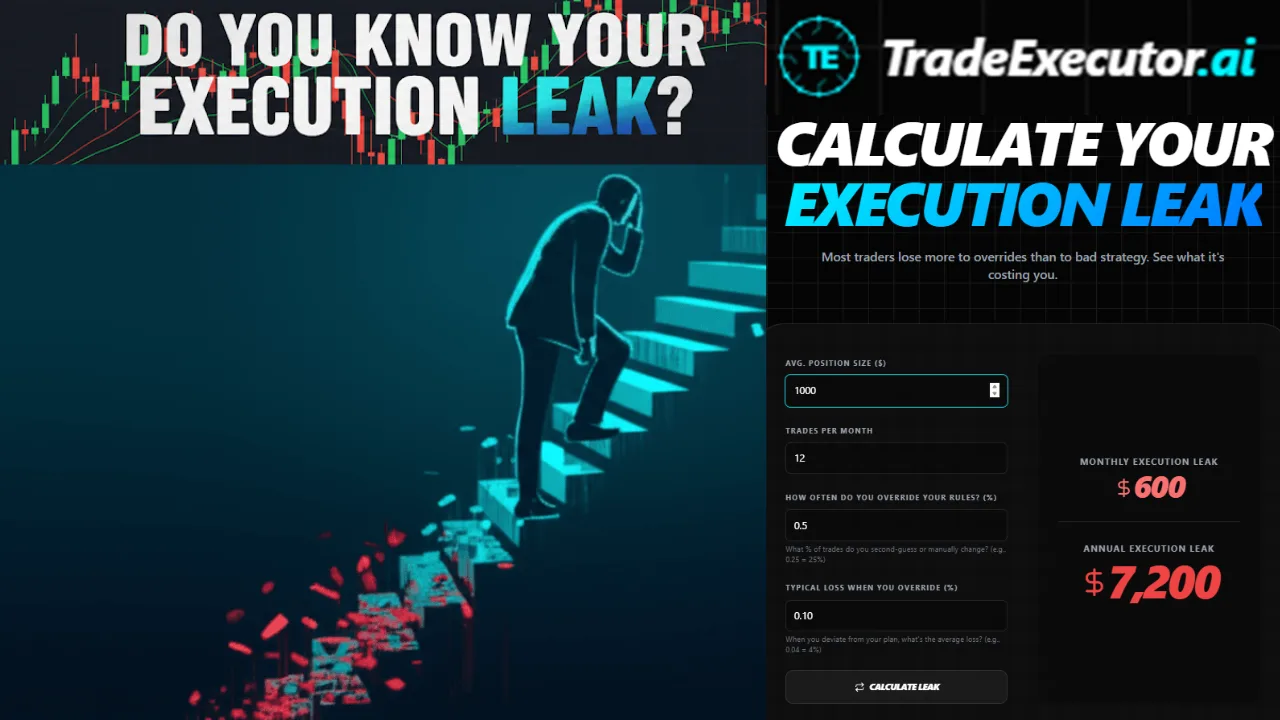
How much is your plan-breaking costing you?
Every deviation from your written rules has a measurable cost. Calculate yours in 30 seconds.
Calculate Your LeakRelated Reading
TradeExecutor.ai — deterministic automated execution engine
← Back to Insights