Oil Plunges, Dow Soars 700 Points: Your Trading Strategy Just Got Tested
The Dow jumped 700 points while oil tumbled as Trump called off evening strikes against Iran. Within hours, energy markets whipsawed, geopolitical risk evaporated, and thousands of discretionary traders scrambled to adjust positions based on breaking news tweets.
TL;DR: Market volatility exposes the fatal flaw in discretionary trading — human emotion between signal and execution. Rules-based strategy systems execute predetermined logic regardless of headlines, eliminating the panic-driven decisions that destroy accounts during events like today's Iran news reversal.The community submitted 1 prediction for AAPL. Every week, the most popular symbol gets publicly reviewed — good or bad.
Submit a Symbol →Does Your Strategy Follow Rules or Headlines?
Rules-based strategies execute predetermined logic without human intervention, while discretionary trading relies on real-time decision-making that emotions often compromise. When Trump's Iran strike reversal hit the wires, automated systems continued following their programmed parameters. Discretionary traders started second-guessing everything.
The difference isn't subtle. A rules-based system running on TradeStation evaluates the same technical indicators, risk parameters, and entry/exit conditions whether oil moves up 5% or down 5%. The Iran headline becomes irrelevant background noise. Human traders, meanwhile, start questioning whether their morning analysis still applies, whether they should close positions early, whether this changes everything.
This fundamental distinction separates consistent performers from emotional casualties. Markets don't care about your feelings, your morning coffee, or your interpretation of geopolitical events. They respond to supply, demand, and mathematical probabilities that remain constant regardless of news cycle drama.
"Down $200 on a day trade. Not much. But I refused to take it. 'It's only $200, it'll come back.' $200 became $400. Then $700. Then $1,200. I finally sold. Six hours of holding. Six hours of hoping...."
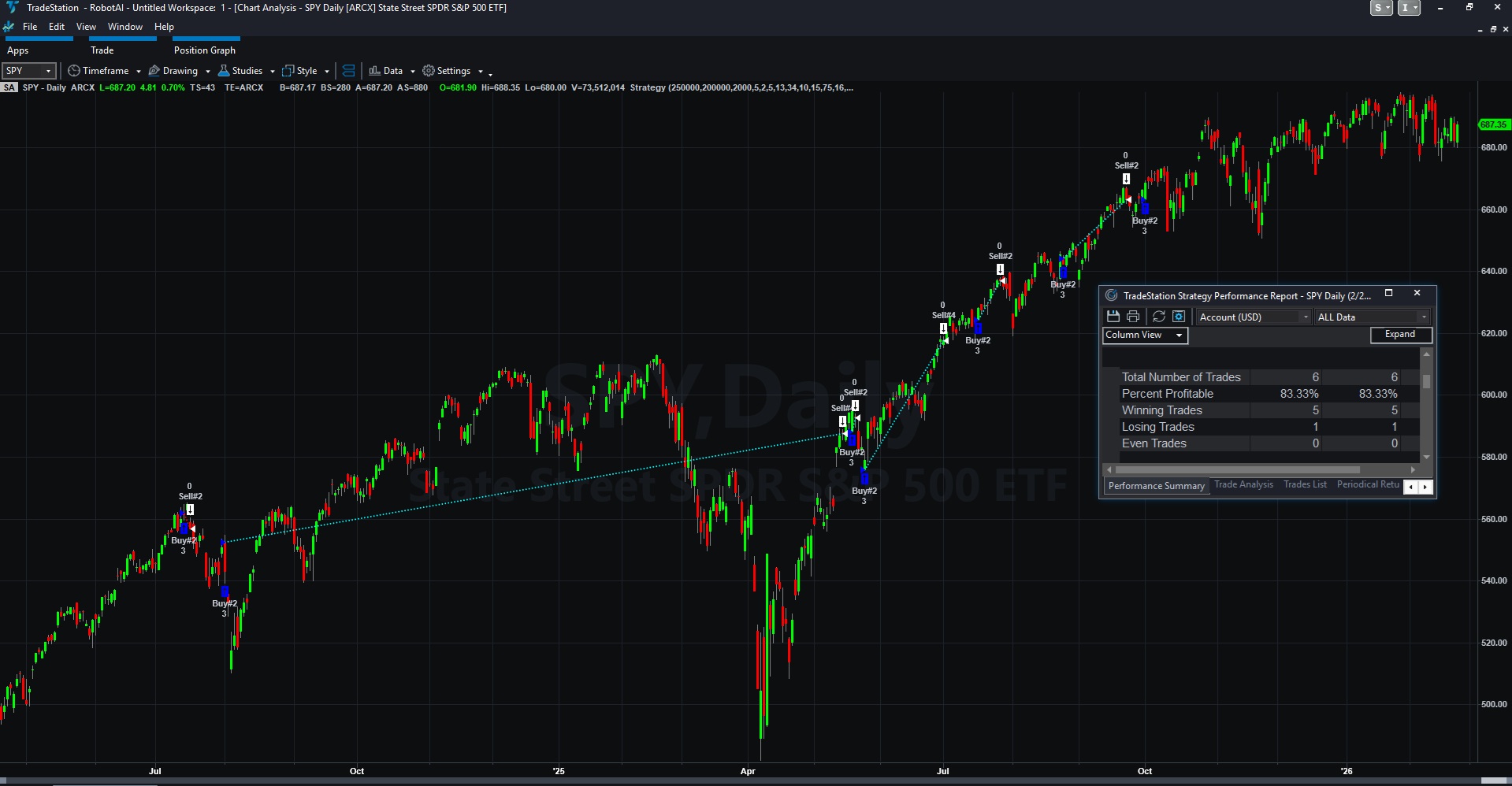
What Happens When Discretionary Traders Panic?
Discretionary traders typically abandon their original analysis and make reactive decisions based on fear or greed during volatile events. The Iran strike news created a perfect case study. At market open, energy positions looked rational based on geopolitical tensions. By afternoon, those same positions felt like mistakes.
Here's the predictable sequence: Energy trader sees oil futures climbing on Iran tensions. Enters long position based on technical setup plus fundamental backdrop. News breaks that strikes are cancelled. Trader immediately questions the position. Fear kicks in. Position gets closed for a loss, despite the original technical setup remaining valid.
The execution leak — the gap between strategy signal and actual trade — widens during volatility. A trader might identify a perfect setup but hesitate to enter because "what if more news drops?" Or they might exit early because "I can't handle another gap down." Each hesitation, each emotional override, creates slippage between theoretical performance and actual results.
Multiply this across thousands of decisions over months of trading, and the cumulative impact becomes devastating. The strategy itself might be profitable, but the human implementation turns it into a loss generator.
How Does Automated Trading Handle Market Volatility?
Automated trading systems execute the same logical framework during high volatility and calm periods, treating each market condition as data inputs rather than emotional events. When oil crashed on the Iran news reversal, automated systems didn't experience fear, didn't question their morning analysis, and didn't scroll Twitter for more updates.
The system evaluates: Does current price action trigger entry conditions? Yes or no. Does position size align with predetermined risk parameters? Calculate and execute. Does technical setup meet exit criteria? Close position accordingly. The Iran headline never enters the decision tree.
This mechanical approach eliminates the behavioral finance disasters that plague human traders. No revenge trading after a loss. No position sizing increases during winning streaks. No strategy abandonment after three consecutive losing trades. Each execution follows identical logic regardless of external circumstances.
TradeExecutor.AI operates on exactly this principle — one strategy, executed identically every time, on one platform where backtesting matches live performance. The system that worked in January operates identically in December, whether Iran dominates headlines or markets drift sideways through summer doldrums.
Should You Change Your Strategy When Oil Crashes?
Strategy changes should only occur after thorough backtesting and statistical analysis, not in response to single market events like oil's Iran-driven volatility. Today's 5% oil move feels significant in the moment, but represents normal market behavior over longer timeframes.
Experienced traders recognize this pattern: dramatic news events create the illusion that "everything has changed" when underlying market mechanics remain constant. Oil still responds to supply and demand. Stocks still reflect earnings expectations. Technical patterns still play out over their historical timeframes.
The urge to modify strategy mid-stream proves strongest during volatile periods. After watching oil tumble on Iran news, the natural impulse suggests adding geopolitical filters, adjusting position sizing, or incorporating news sentiment analysis. Each modification introduces new variables that require separate testing and validation.
Rules-based systems resist this temptation through mechanical consistency. The strategy operates identically whether oil moves 5% up, 5% down, or stays flat. Market conditions become inputs to evaluate, not reasons to change the evaluation framework itself.
What Is an Execution Leak in Trading?
Execution leak represents the performance gap between your strategy's theoretical results and actual trading outcomes, caused by human decision-making inconsistencies. Every hesitation, every emotional override, every "just this once" deviation creates slippage that compounds over time.
Consider today's scenario: Your energy strategy signals a long crude oil position based on technical indicators. But Iran headlines create uncertainty. You either skip the trade entirely, take a smaller position, or enter late after "seeing how it plays out." Each modification leaks performance compared to mechanical execution.
The leak isn't always obvious. Missing one trade might actually improve short-term results if that particular signal fails. But statistical edges only work across large sample sizes. Skip enough signals due to uncomfortable market conditions, and you eliminate the trades that generate long-term profitability.
Professional traders quantify this leak by comparing strategy backtests against actual account performance. The difference — often 20-40% annually — represents the cost of human involvement in mechanical processes. TradeExecutor.AI eliminates this gap by removing human decision-making from every execution step.
Why One Strategy Beats Strategy Switching?
One thoroughly tested strategy consistently outperforms multiple strategies because it allows proper statistical sample sizes and eliminates the timing errors inherent in switching systems. Traders who jump between strategies during drawdowns never experience the full cycle that generates long-term profits.
Today's Iran news creates a perfect switching temptation. Energy-focused strategies suddenly look problematic. Geopolitical risk models seem essential. The grass appears greener in completely different market sectors. This thinking destroys more trading accounts than market volatility ever could.
Statistical edges require hundreds or thousands of trades to manifest. A strategy with 55% win rate and proper risk management generates profits over 500 trades but might lose money over 50 trades. Switch strategies every few months, and you never reach sample sizes where mathematical advantages compound into real returns.
TradeExecutor focuses on one strategy, one platform, because depth beats breadth in systematic trading. Instead of mediocre execution across multiple approaches, the system delivers optimal execution of one thoroughly tested methodology. The strategy handles energy volatility, geopolitical events, and market regime changes through consistent application of proven logic.
The TradeStation Advantage for Rules-Based Execution
TradeStation provides the infrastructure reliability and backtesting accuracy essential for rules-based strategies, ensuring that historical testing matches live execution performance. When automated systems execute oil trades during Iran-driven volatility, platform stability becomes critical for maintaining mechanical consistency.
The platform's EasyLanguage environment allows precise strategy translation from concept to code. Every entry condition, exit parameter, and risk management rule gets programmed exactly as designed. No interpretation errors. No execution delays. No platform-specific modifications that invalidate backtesting results.
This technical foundation supports TradeExecutor's core value proposition: deterministic execution where identical inputs always produce identical outputs. Whether oil crashes on Iran news or gaps higher on supply disruptions, the strategy operates through identical platform infrastructure with identical execution logic.
The one-platform approach eliminates variables that compromise systematic trading. No broker differences. No API inconsistencies. No execution timing variations. The same TradeStation environment used for backtesting handles live trading, creating seamless transition from testing to implementation.
Calculate Your Real Trading Cost
Most traders underestimate their execution leak by 50-80% because they focus on winning trades while ignoring the compound impact of missed signals and emotional overrides. Today's Iran volatility created dozens of leak opportunities: trades skipped due to uncertainty, positions closed early due to fear, entries delayed due to hesitation.
Track every deviation from your original strategy over the next month. Log each trade you skip, each position size you modify, each exit you accelerate due to market conditions. Calculate the performance difference between perfect mechanical execution and your actual results. The number will surprise you.
The cost extends beyond individual trades. Each emotional override reinforces discretionary habits that compound over time. Skip energy trades during geopolitical uncertainty, and you'll find reasons to skip other sectors during their challenging periods. The strategy erosion spreads until systematic trading becomes completely discretionary.
TradeExecutor.AI eliminates this calculation entirely by removing human decision-making from every execution step. The system that backtested profitably over historical data operates identically during live trading, regardless of Iran headlines, oil volatility, or any other external distraction.
Ready to see what systematic execution looks like? Explore our rules-based strategy that handles market volatility through mathematical consistency, not emotional reactions.
Tested. Trusted. Transparent.
How much is your execution leak costing you?
Most traders lose more to overrides than to bad strategy. Calculate yours in 30 seconds.
Calculate Your LeakTradeExecutor.ai — deterministic automated execution engine
← Back to Insights