The Dow's 800-Point Drop Reveals Why Rules Beat Reactions
The Dow just shed nearly 800 points. The S&P 500 marked its fifth straight losing week. Your phone is buzzing with market alerts, financial news is painting apocalyptic scenarios, and somewhere, a trader just clicked "sell all" on their entire portfolio at the worst possible moment.
Here's what separates profitable traders from the casualties: the ones making money right now are following predetermined rules, not reacting to headlines. While discretionary traders scramble to "adjust" their approach, automated systems execute exactly as programmed—no panic, no overrides, no emotional decisions that turn temporary drawdowns into permanent losses.
The difference isn't luck. It's discipline. And discipline, as every veteran trader knows, is nearly impossible to maintain when markets are bleeding red.
The community submitted 1 prediction for AAPL. Every week, the most popular symbol gets publicly reviewed — good or bad.
Submit a Symbol →Market Crashes Don't Kill Strategies—Humans Do
Every significant market correction follows the same script. Professional traders with backtested rules-based strategy systems continue executing their predetermined plan. Meanwhile, retail traders abandon their methodology at precisely the moment they need it most.
The statistics are brutal: during the March 2020 crash, disciplined systematic traders who stuck to their rules recovered within months. Emotional traders who sold at the bottom? Many never recovered their losses because they bought back in after markets had already rebounded.
This isn't about having a crystal ball. It's about having a system that removes the human failure point between signal and action. When your strategy is rules-based, market volatility becomes data to process, not drama to react to.
The traders losing sleep tonight aren't the ones running automated systems. They're the ones second-guessing every position, checking their phones every five minutes, and convincing themselves that "this time is different."
"Down $200 on a day trade. Not much. But I refused to take it. 'It's only $200, it'll come back.' $200 became $400. Then $700. Then $1,200. I finally sold. Six hours of holding. Six hours of hoping...."
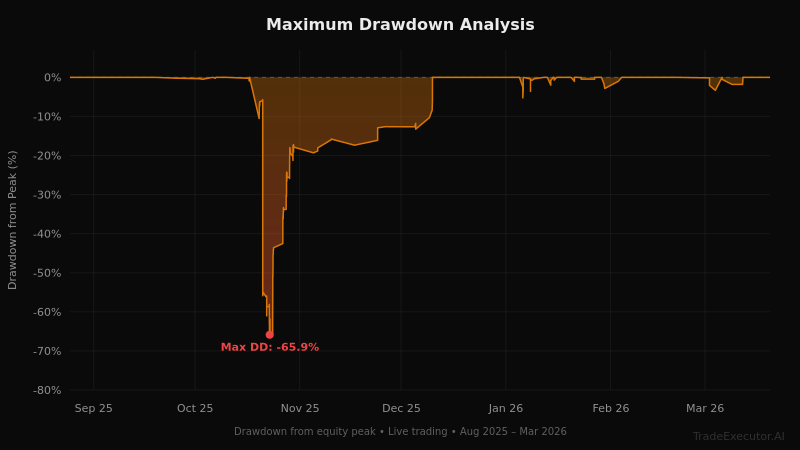

What Panic Looks Like vs. What Discipline Executes
Picture two traders watching the same 800-point drop unfold:
Trader A (Discretionary): Sees the plunge, immediately questions their open positions. Thinks "maybe I should cut my losses before it gets worse." Checks news feeds for "clues" about tomorrow's direction. Eventually overrides their original plan and sells at exactly the wrong time—when fear is highest and prices are lowest. Spends the weekend wondering if they made the right call. Trader B (Rules-Based): Their automated system scans the same market data through predetermined logic. If the strategy's entry conditions trigger, positions are opened. If exit conditions are met, positions are closed. No news checking. No second-guessing. No weekend anxiety. The system executes exactly as backtested, regardless of headlines or emotions.The difference isn't intelligence—it's consistency. Trader B's approach is deterministic: same inputs produce same outputs, every single time. Trader A's approach changes based on fear, hope, and the last CNBC segment they watched.
Which trader do you think sleeps better? More importantly, which one keeps their money longer?
Should You Change Your Trading Rules During Market Corrections?
This is the question every trader faces during volatile periods. The answer reveals everything about your approach to risk management.
If your strategy was properly backtested across multiple market conditions—including corrections, crashes, and recovery periods—then changing rules mid-correction is like switching lanes in traffic during a storm. You're most likely to crash when you're moving around the most.
TradeExecutor.AI's approach eliminates this temptation entirely. One strategy, one platform, predetermined logic that's been tested across various market environments. When volatility spikes, the system doesn't panic or pivot—it processes data and executes according to rules that were proven long before today's headlines existed.
The traders who consistently profit through corrections aren't the ones with the best market predictions. They're the ones with the most consistent execution. They understand that market crashes test your discipline, not your strategy.
The Hidden Cost of Emotional Override
Here's what most traders never calculate: execution leak. This is the gap between what your strategy should produce and what your account actually shows. Every time you override your rules—whether from fear, greed, or "market intuition"—you create leak.
During volatile periods, execution leak accelerates. You exit positions early because the drawdown "feels" too big. You skip entries because the setup "looks" risky. You hold losers too long hoping for recovery. Each override compounds, turning a profitable strategy into a losing account.
Rules-based automated systems eliminate this leak entirely. They execute exactly as programmed, with no emotional interference between signal and action. The strategy's theoretical performance becomes your actual performance.
This is why TradeExecutor.AI focuses obsessively on execution fidelity. The best strategy in the world is worthless if human emotion corrupts its implementation. Remove the human failure point, and suddenly your backtested results become achievable in live trading.
When Markets Test Your System, Not Your Nerves
Professional systematic traders view market corrections differently than retail traders. They see stress tests, not disasters. When their automated systems continue executing during volatility, they're gathering real-world validation of their backtesting.
This perspective shift changes everything. Instead of asking "should I be scared?" you ask "is my system performing as expected?" Instead of reacting to price movements, you monitor system performance. Instead of changing strategies during drawdowns, you trust the process that was proven before the drawdown began.
TradeExecutor.AI embodies this philosophy completely. One strategy, thoroughly backtested, consistently executed. No discretion, no emotion, no overrides. When markets drop 800 points, the system processes this information through the same logic that handled every other trading day.
The result? Performance that matches backtesting. Execution without leak. Results that reflect strategy, not psychology.
Today's market correction will pass, like every correction before it. The question isn't whether markets will recover—they always do. The question is whether your trading approach will survive your own reactions to temporary volatility.
Rules-based execution isn't just about avoiding bad decisions during crashes. It's about maintaining consistent performance regardless of market conditions or emotional states. It's about turning trading from a psychological battle into a systematic process.
Tested. Trusted. Transparent.How much is your execution leak costing you?
Most traders lose more to overrides than to bad strategy. Calculate yours in 30 seconds.
Calculate Your LeakTradeExecutor.ai — deterministic automated execution engine
← Back to Insights