How to Reduce Execution Leak in Trading: A Rule-Based Approach
Traders lose an average of 2-5% annually to execution leak—the gap between intended trades and actual trades—yet most don't even realize it's happening. When markets move fast and emotions run high, the difference between what your strategy signals and what you actually execute can cost thousands of dollars per month.
TL;DR: Execution leak occurs when traders deviate from their planned trades due to emotion, hesitation, or second-guessing. Rules-based strategy execution eliminates this gap by removing human discretion entirely, ensuring every signal becomes an action without delay or modification.The community submitted 1 prediction for AAPL. Every week, the most popular symbol gets publicly reviewed — good or bad.
Submit a Symbol →What Is an Execution Leak in Trading?
Execution leak is the performance gap between your strategy's theoretical results and your actual trading results. This leak happens when you hesitate on a stop loss, chase a breakout after missing the entry, or skip trades because they "don't feel right."
The numbers tell the story: A strategy that backtests at 12% annual returns might deliver only 8% in live trading. That 4% difference—the execution leak—compounds over time. On a $100,000 account, execution leak costs $4,000 annually. Over ten years, that's $48,000 in lost opportunity.
Most traders blame market conditions or bad luck. The real culprit is the human element between signal and execution.
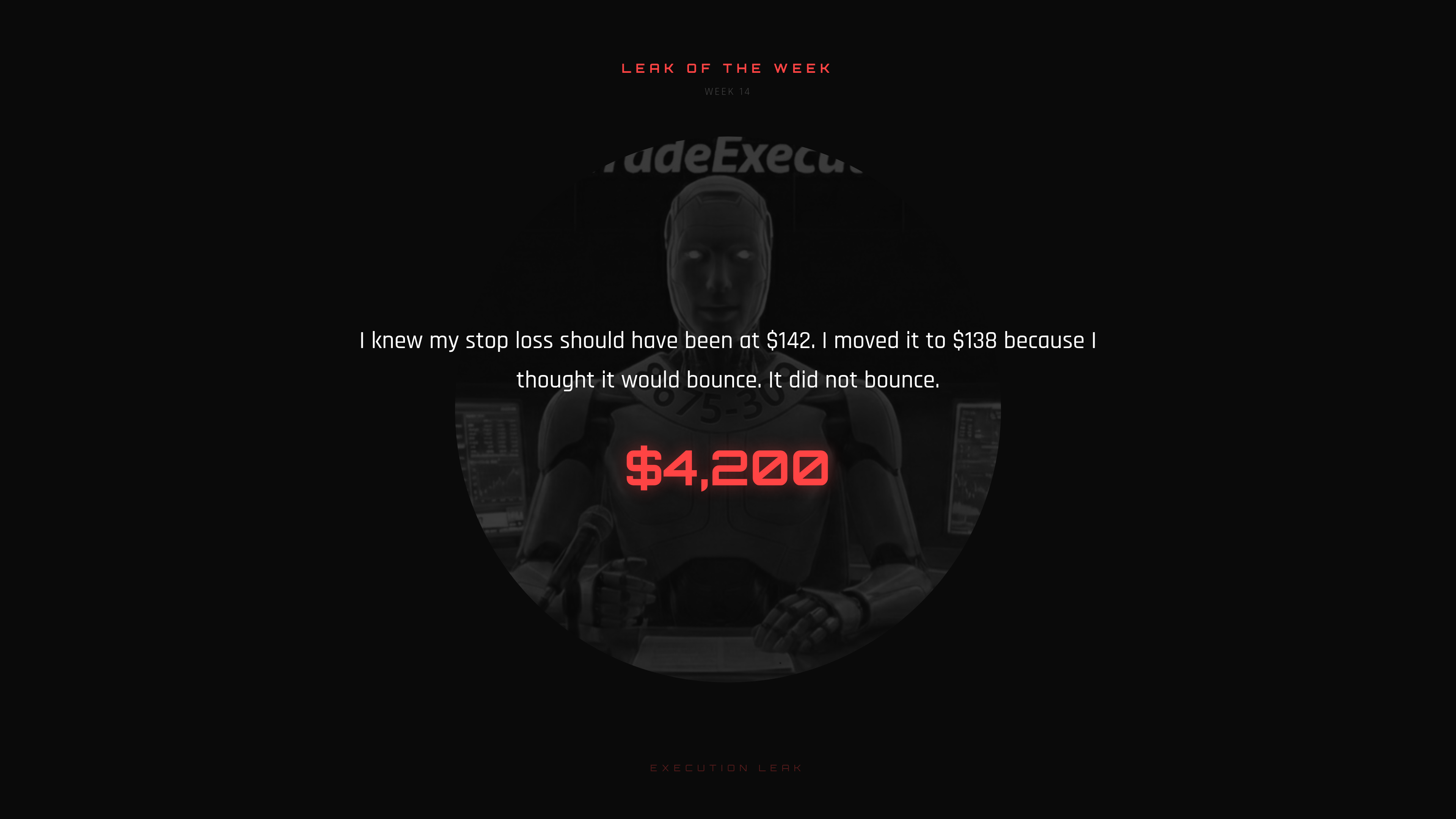
"Down $200 on a day trade. Not much. But I refused to take it. 'It's only $200, it'll come back.' $200 became $400. Then $700. Then $1,200. I finally sold. Six hours of holding. Six hours of hoping...."

Why Do Traders Break Their Own Rules?
Traders abandon their rules because emotions override logic in real-time trading. Fear kicks in when a position moves against them. Greed takes over when profits start running. Hope keeps them in losing trades longer than planned.
The pattern repeats: You develop a solid strategy, backtest it thoroughly, then modify it on the fly during live trading. You tell yourself you're "reading the market," but you're actually introducing inconsistency that destroys edge.
This isn't a character flaw—it's human nature. The same cognitive biases that help us in daily life work against us in trading. The solution isn't more willpower; it's removing the decision point entirely.
How Does Automated Trading Handle Volatility?
Automated trading systems execute trades based on predetermined rules without emotional interference. When volatility spikes and human traders freeze or panic, automated systems continue following their programmed logic.
During market stress, automated systems maintain discipline. They don't skip trades because the market "feels scary." They don't hold losing positions hoping for a reversal. They don't exit winners early because they're nervous about giving back profits.
The system executes every signal exactly as programmed, creating consistency between backtested expectations and live results. This consistency is what eliminates execution leak.
Should You Override Your System During Market Stress?
Never override a properly backtested system during volatile periods. The urge to intervene usually strikes at the worst possible moments—exactly when discipline matters most.
Market stress reveals who has real edge and who's been lucky. Systems that perform well across different market conditions, including stress periods, prove their robustness through consistency, not through human intervention.
TradeExecutor.AI prevents overrides entirely. Once the system is running, there's no temptation to "just this once" modify a trade. The rules execute automatically, removing the human failure point that destroys most trading accounts.
What Are the Hidden Costs of Discretionary Trading?
Discretionary trading carries costs beyond obvious losses. Mental fatigue from constant decision-making reduces judgment quality throughout the day. Analysis paralysis causes missed opportunities. Second-guessing creates inconsistent position sizing.
Time costs compound these issues. Discretionary traders spend hours watching charts, researching setups, and managing active positions. This time investment rarely correlates with better results—often the opposite.
The biggest hidden cost is opportunity cost. While you're micro-managing one position, three other valid setups might pass unnoticed. Automated systems can monitor multiple markets simultaneously without missing signals.
How Do You Calculate Your Execution Leak?
Compare your strategy's backtested results with your actual trading results over the same timeframe. The difference is your execution leak. Track these specific metrics: trades skipped, early exits, late entries, and position size deviations.
Most traders discover their execution leak ranges from 20-40% of their strategy's theoretical performance. A strategy that should generate 15% annually might deliver only 9-12% in practice. The larger the leak, the greater the benefit from automation.
Calculate the dollar cost: If your execution leak is 3% annually on a $200,000 account, you're losing $6,000 per year to avoidable human errors. Over a decade, that's $60,000 in unnecessary losses.
Why Choose Rules-Based Execution Over Discretionary Trading?
Rules-based execution produces deterministic results—the same inputs always generate the same outputs. This consistency allows for accurate backtesting and realistic performance expectations.
Discretionary trading introduces variables that can't be backtested: your mood, market news interpretation, and split-second judgment calls. These variables make it impossible to predict future performance based on historical results.
TradeExecutor.AI eliminates these variables by executing predetermined rules without modification. Every trade happens exactly as the strategy dictates, creating a direct link between backtested expectations and live results.
What Makes TradeStation Ideal for Automated Execution?
TradeStation provides the infrastructure for reliable automated execution without the complexity of multiple platforms. Their EasyLanguage programming environment allows for precise rule implementation and testing.
The platform's direct market access ensures fast execution speeds, critical for strategies that depend on quick fills. Built-in backtesting tools let you verify strategy performance before going live, while real-time execution mirrors backtested conditions.
Using one platform for development, testing, and execution eliminates compatibility issues and reduces failure points. TradeExecutor.AI leverages TradeStation's reliability to deliver consistent, automated execution on a transparent, tiered pricing model — free to start, then scaling from $9.99/mo to $699/mo based on how much capital you're executing.
How to Start Eliminating Execution Leak Today
Begin by documenting every trade deviation from your original plan. Track when you enter late, exit early, or skip trades entirely. This documentation reveals your specific leak patterns.
Next, define your strategy rules precisely enough that someone else could execute them identically. Vague rules like "exit when momentum weakens" leave room for interpretation. Specific rules like "exit when RSI crosses below 30" eliminate ambiguity.
Finally, implement automated execution to remove human intervention entirely. TradeExecutor.AI handles this implementation, ensuring every signal becomes an action without delay or modification.
Your trading edge exists in your strategy, not in your ability to improve it real-time. Protect that edge by eliminating the human element between signal and execution. Stop losing money to preventable execution errors.
Tested. Trusted. Transparent.
How much is your execution leak costing you?
Most traders lose more to overrides than to bad strategy. Calculate yours in 30 seconds.
Calculate Your LeakTradeExecutor.ai — deterministic automated execution engine
← Back to Insights