Oil Spikes, S&P Stumbles: When Volatility Exposes Your Trading Weakness
The S&P 500 just pulled back from record highs as oil prices surge, and somewhere right now, a trader is staring at their screen wondering if they should abandon their strategy. Energy volatility has a way of making even seasoned traders second-guess everything they know.
TL;DR: Market volatility doesn't break rules-based trading systems — it reveals why discretionary traders fail. When oil moves 5% overnight, automated execution follows predetermined rules while human traders panic and create costly execution leaks.Oil's sudden momentum isn't just moving energy stocks. It's exposing the fundamental flaw in discretionary trading: the gap between knowing what to do and actually doing it. Today's pullback is a perfect case study in why rules-based strategy execution matters more than market prediction.
The community submitted 1 prediction for AAPL. Every week, the most popular symbol gets publicly reviewed — good or bad.
Submit a Symbol →Does Your Strategy Follow Rules or Hype?
Your strategy either operates on predetermined rules or it doesn't — there's no middle ground. Rules-based systems execute the same way whether oil jumps 2% or 8%, whether the S&P hits new highs or drops 200 points.
Discretionary traders tell themselves they're "adapting to market conditions," but adaptation often means abandoning the very rules that made their strategy profitable in backtesting. When oil volatility spikes, discretionary traders start asking questions that have nothing to do with their original strategy: Should I hedge energy exposure? Is this the start of an inflation spike? Should I reduce position sizes?
Rules-based execution asks only one question: What does my strategy say to do right now? The answer comes from backtested parameters, not from CNBC headlines or gut feelings about oil prices.
"Down $200 on a day trade. Not much. But I refused to take it. 'It's only $200, it'll come back.' $200 became $400. Then $700. Then $1,200. I finally sold. Six hours of holding. Six hours of hoping...."
What Happens When Discretionary Traders See Oil Volatility?
Discretionary traders create execution leaks when energy markets move unexpectedly. They hesitate on entries, exit positions early, or override their rules based on oil price movements that may have zero correlation with their actual trading strategy.
Consider today's scenario: Oil gains momentum, S&P pulls back from records. A discretionary trader running a momentum strategy might see the oil spike and think, "Maybe I should wait for this energy volatility to settle before taking my next trade." That hesitation creates an execution leak — the gap between what their strategy signals and what they actually execute.
The same trader might exit a profitable position early because "oil uncertainty" feels dangerous, even though their strategy's exit rules haven't triggered. Every override, every hesitation, every early exit based on energy market fear moves their live results further from their backtested performance.
How Does Automated Trading Handle Volatility?
Automated trading systems execute trades based on predetermined rules, regardless of oil prices, market headlines, or volatility spikes. When the S&P pulls back from records while oil surges, an automated system checks its rules and executes accordingly — no hesitation, no second-guessing.
TradeExecutor.AI runs the same strategy logic whether oil moves 1% or 10%. The system doesn't read CNBC headlines about energy momentum or try to interpret what oil volatility means for broader markets. It follows the same backtested rules that generated its historical performance.
This deterministic approach means the same inputs always produce the same outputs. Oil volatility might affect market prices, but it doesn't affect execution quality. The strategy either has rules for volatile conditions or it doesn't — and if it doesn't, no amount of discretionary "smart" overrides will fix that gap.
Should You Change Your Strategy When Oil Crashes?
You should never change your strategy based on individual commodity moves unless those moves were specifically accounted for in your strategy development and backtesting. Oil volatility is just another market condition, not a reason to abandon proven rules.
Strategy changes should come from systematic analysis of performance data, not from reactive responses to energy market headlines. If your strategy hasn't accounted for oil volatility in its development and testing, then oil spikes reveal a gap in your strategy design — not a need for discretionary overrides.
Rules-based systems handle this correctly by separating strategy performance from execution quality. If oil volatility hurts performance, that's a strategy issue to address through systematic backtesting and refinement. But changing execution rules on the fly based on energy market movements typically makes performance worse, not better.
What Is an Execution Leak in Trading?
An execution leak is the performance gap between your strategy's backtested results and your live trading results, caused by human decision-making during trade execution. Every hesitation, override, or "smart" adjustment creates execution leak.
Execution leaks compound over time. Missing one entry due to oil market uncertainty might cost you 2% on that trade. Early exits based on energy volatility fears might cost another 1.5% across three positions. These small leaks add up to significant performance degradation over months of trading.
TradeExecutor.AI eliminates execution leaks by removing human decision-making from the execution process. The system doesn't care if oil is up 5% or down 3% — it executes based on the same rules that produced its backtested performance. No emotion, no overrides, no discretionary "improvements" that typically make results worse.
Why Platform Integration Matters During Volatile Periods
Volatile periods expose weaknesses in trading infrastructure, not just strategy rules. When oil spikes and markets move fast, execution speed and reliability become critical factors in maintaining strategy performance.
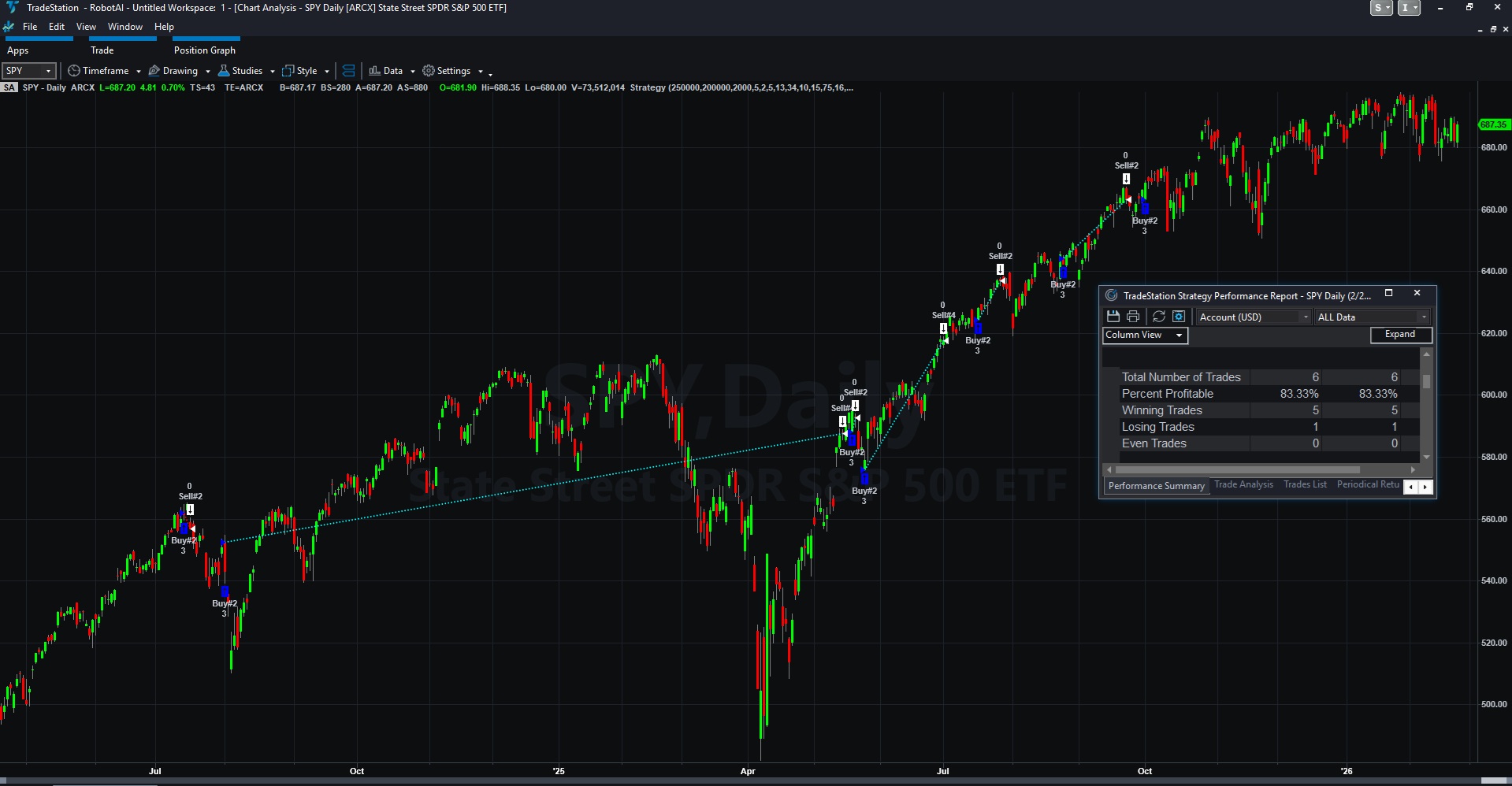
TradeExecutor.AI integrates directly with TradeStation, eliminating the delays and errors that come from manual order entry during volatile periods. While discretionary traders struggle to keep up with fast-moving energy markets, automated execution maintains consistent order timing and accuracy.
This integration advantage becomes most valuable precisely when markets are most chaotic. Oil volatility creates the conditions where manual execution fails most often — rushed orders, missed fills, incorrect position sizes. Automated execution through TradeStation handles volatile periods with the same precision as calm markets.
The Real Cost of Energy Market Emotion
Emotional responses to energy volatility cost traders money through poor execution, not just poor strategy decisions. Fear about oil price movements leads to hesitation on entries, early exits on winners, and position sizing based on comfort rather than strategy rules.
Today's oil-driven market pullback will trigger thousands of emotional trading decisions. Traders will exit positions that haven't hit their stop levels. They'll skip entries because energy uncertainty "feels" dangerous. They'll reduce position sizes based on oil volatility that has nothing to do with their actual trading signals.
These emotional responses create measurable performance gaps. Rules-based execution eliminates this emotional cost by removing human feelings from the execution process entirely. Markets can be volatile; execution doesn't have to be.
TradeExecutor.AI turns strategy rules into consistent action, whether oil is making headlines or trading quietly. One strategy, one platform, deterministic execution that matches backtested performance. When the next energy shock hits markets, rules-based systems keep executing while discretionary traders second-guess their way to underperformance.
Tested. Trusted. Transparent.
How much is your execution leak costing you?
Most traders lose more to overrides than to bad strategy. Calculate yours in 30 seconds.
Calculate Your LeakTradeExecutor.ai — deterministic automated execution engine
← Back to Insights