Oil Slides 5%, Markets Rise: Why Rules-Based Traders Stay Calm While Others Panic
The S&P 500, Nasdaq, and Dow all climbed higher today as oil prices tumbled and earnings season delivered solid results. While discretionary traders scrambled to adjust positions and second-guess their energy exposure, rules-based systems executed their predetermined logic without hesitation.
TL;DR: Rules-based execution removes the emotional whipsaw that destroys returns during volatile sessions. When oil drops 5% overnight, automated systems follow their tested parameters while human traders make fear-driven mistakes that create execution leaks.The difference isn't just philosophical—it's measurable. Every override, every "just this once" deviation, every emotional adjustment creates what professionals call execution leak: the gap between what your strategy should do and what actually happens in your account.
The community submitted 1 prediction for AAPL. Every week, the most popular symbol gets publicly reviewed — good or bad.
Submit a Symbol →Does Your Strategy Follow Rules or Headlines?
Your strategy either has rules or it doesn't. There's no middle ground when oil crashes 5% in a single session and energy stocks start flashing red across your watchlist.
A rules-based approach defines exact entry and exit conditions before the market opens. Position sizing follows predetermined formulas. Stop losses trigger at specific price levels regardless of whether the move "feels" overdone. The rules-based strategy operates the same way whether oil rises 10% or falls 10%—because volatility was already factored into the backtested parameters.
Discretionary trading, by contrast, leaves room for interpretation. "I'll usually exit when momentum weakens" becomes "but this oil selloff seems overdone, so I'll hold longer." That flexibility sounds sophisticated until you realize it's the exact mechanism that destroys consistent returns.
"Down $200 on a day trade. Not much. But I refused to take it. 'It's only $200, it'll come back.' $200 became $400. Then $700. Then $1,200. I finally sold. Six hours of holding. Six hours of hoping...."
What Happens When Discretionary Traders See Oil Volatility?
Discretionary traders typically make three costly mistakes during energy volatility sessions like today's 5% oil decline.
First, they adjust position sizes based on recent price action rather than predetermined risk parameters. Yesterday's 2% energy allocation becomes today's 0.5% allocation because "oil looks unstable right now." This backward-looking position sizing ensures you're always fighting the last war instead of following a tested approach.
Second, they override exit signals when the news "explains" the move. "Oil is down 5% but it's just profit-taking after last week's gains" becomes justification to hold positions that should have been closed according to the original strategy. These overrides accumulate into significant execution leak over time.
Third, they add market timing layers that weren't part of their original system. "I'll wait until oil stabilizes before entering new positions" sounds prudent but introduces discretionary elements that were never backtested or validated.
How Does Automated Trading Handle Market Volatility?
Automated trading handles volatility through predetermined logic that executes regardless of market conditions or news headlines.
When oil drops 5% like today, an automated system references its coded parameters: if energy positions hit predetermined stop levels, they close. If volatility-adjusted position sizing formulas reduce allocation to energy names, the system adjusts. If momentum indicators trigger new entries in other sectors benefiting from lower oil prices, those trades execute.
The system doesn't read headlines about "solid earnings rolling in" or interpret whether oil's decline represents a buying opportunity or the start of a larger selloff. These judgments, however educated, introduce variability that undermines the statistical edge that comes from consistent execution.
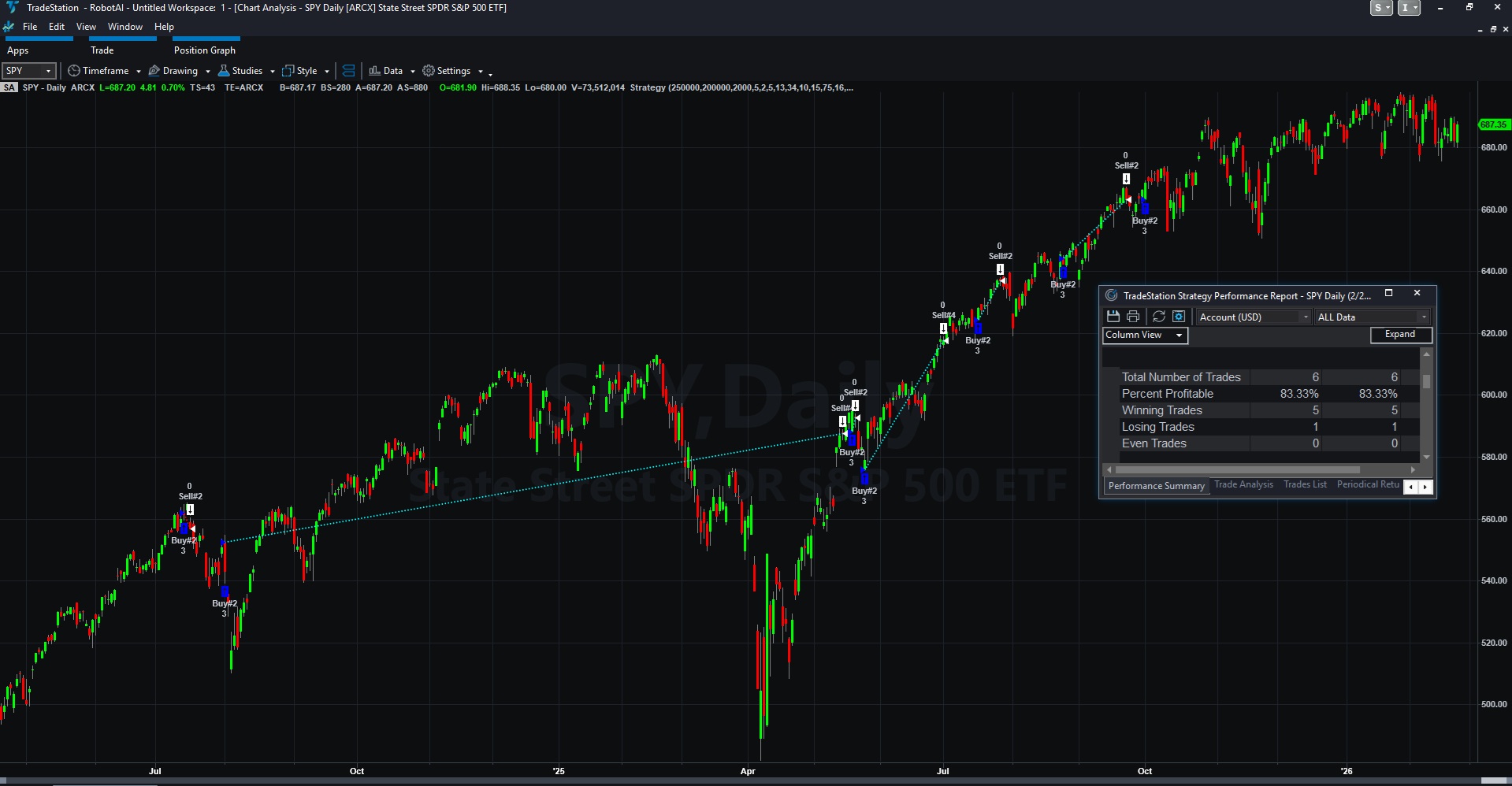
TradeExecutor.AI demonstrates this principle through its integration with TradeStation's infrastructure. The same strategy logic that was backtested gets executed in live markets without modification, interpretation, or emotional adjustment.
Should You Change Your Strategy When Oil Crashes?
No, you should execute your existing strategy more consistently, not change it based on today's oil price action.
Strategy changes should come from systematic analysis of long-term performance data, not from individual market sessions where oil slides 5% and creates temporary volatility. A properly designed strategy already accounts for energy price swings, market rotations, and earnings-driven moves through its risk management and position sizing components.
The urge to "improve" your strategy during volatile sessions like today typically leads to optimization bias—adjusting parameters to handle recent market action while inadvertently reducing performance in other market conditions. This creates a system that's perfectly designed for last week's market environment.
Rules-based execution prevents these real-time modifications by removing the human decision point between signal generation and trade execution. When your system generates a signal, that signal executes without interpretation, regardless of whether oil is up 5% or down 5%.
What Is an Execution Leak in Trading?
Execution leak is the performance difference between your strategy's theoretical returns and your actual account returns, typically caused by discretionary overrides and emotional decision-making.
Every time you decide to "wait and see" instead of taking a predetermined entry, that's execution leak. Every position you hold longer than your exit rules specify creates execution leak. Every trade size you adjust based on recent market action rather than systematic position sizing formulas generates execution leak.
These individual decisions seem rational in isolation but compound into significant performance degradation over time. A strategy that backtests at 15% annual returns might deliver 8% in live trading due to accumulated execution leak from hundreds of small overrides and adjustments.
TradeExecutor.AI eliminates execution leak by removing the human element between signal generation and trade execution. The same logic that produced the backtested results operates in your live account without modification or interpretation.
Why One Strategy, One Platform Matters
Multiple strategies across multiple platforms multiply your opportunities for execution errors and inconsistent implementation.
Running a momentum strategy on one platform while manually trading mean reversion setups on another creates competing signals and decision fatigue. When oil drops 5% like today, which system takes priority? How do you ensure position sizing remains consistent across platforms? These complications introduce discretionary elements that weren't part of your original testing.
TradeExecutor.AI's approach eliminates these complications through focus: one thoroughly tested strategy operating through one integrated platform. TradeStation's infrastructure handles the execution while the rules-based logic handles the decisions. This integration ensures that backtested performance translates directly to live trading results.
The one-time payment model aligns with this focused approach—you're not paying recurring fees that incentivize complexity or over-trading, just accessing a tested system that executes consistently regardless of market conditions.
Your choice isn't between different trading approaches—it's between systematic execution and systematic degradation through emotional overrides. Today's oil volatility is just another test of which approach you're actually implementing in your account.
Tested. Trusted. Transparent.
How much is your execution leak costing you?
Most traders lose more to overrides than to bad strategy. Calculate yours in 30 seconds.
Calculate Your LeakTradeExecutor.ai — deterministic automated execution engine
← Back to Insights