S&P 500 Hits Record High While Oil Plunges: Does Your Strategy Follow Rules or Hype?
The S&P 500 opened May with fresh record highs while crude oil tumbled and Apple shares surged — a perfect storm that separates disciplined traders from emotional ones. TL;DR: Rules-based execution systems maintain consistency during volatile market events because they follow predetermined logic, while discretionary traders often abandon their strategies when headlines scream and prices swing wildly.
Right now, thousands of traders are staring at screens, second-guessing their positions as energy stocks whipsaw and tech names rally. The question isn't whether volatility will continue — it will. The question is whether your trading execution follows a tested rules-based strategy or gets hijacked by the latest market narrative.
The community submitted 1 prediction for AAPL. Every week, the most popular symbol gets publicly reviewed — good or bad.
Submit a Symbol →Should You Change Your Strategy When Oil Crashes?
No, you should not change your strategy when oil crashes — if your strategy is properly backtested and rules-based. Strategy changes during volatile events typically destroy more capital than the volatility itself.
When crude oil drops 5% overnight, discretionary traders start making exceptions. "Maybe I should exit energy positions early." "Perhaps I should add to tech since it's rallying." These real-time strategy modifications feel logical but consistently underperform systematic approaches.
A rules-based system processes the same oil crash differently. If the strategy parameters don't trigger an exit signal, no exit occurs. If position sizing rules call for maintaining exposure, exposure remains unchanged. The system doesn't read headlines about energy sector weakness or analyst downgrades — it reads price, volume, and mathematical indicators.
This isn't about being stubborn. This is about recognizing that strategy development happens during calm periods with historical data, not during volatile periods with emotional pressure.
"Down $200 on a day trade. Not much. But I refused to take it. 'It's only $200, it'll come back.' $200 became $400. Then $700. Then $1,200. I finally sold. Six hours of holding. Six hours of hoping...."
What Happens to Discretionary Traders During Market Volatility?
Discretionary traders typically experience execution leaks and strategy drift during market volatility, leading to underperformance versus their intended approach. The human brain interprets sudden price movements as immediate threats requiring action.
Consider today's energy volatility. A discretionary trader sees oil falling, energy stocks declining, and immediately starts questioning their positions. "Should I cut losses now?" "What if this gets worse?" "Maybe I should wait for a better entry." Each question introduces hesitation, delay, or premature action.
The execution leak grows with each decision. Entry signals get delayed because "maybe it will get cheaper." Exit signals get ignored because "maybe it will bounce back." Position sizes get adjusted because "this feels too risky right now." Every modification moves actual performance further from backtested expectations.
Meanwhile, automated systems execute exactly what they're programmed to execute. Entry signals trigger entries. Exit signals trigger exits. Position sizing remains consistent with tested parameters. No headlines change the logic. No price swings modify the approach.
How Does Automated Trading Handle Volatility?
Automated trading handles volatility by executing predetermined rules without emotional interference, maintaining consistent performance regardless of market conditions. The system treats a 5% oil crash identically to a 5% oil rally — as data points within programmed parameters.
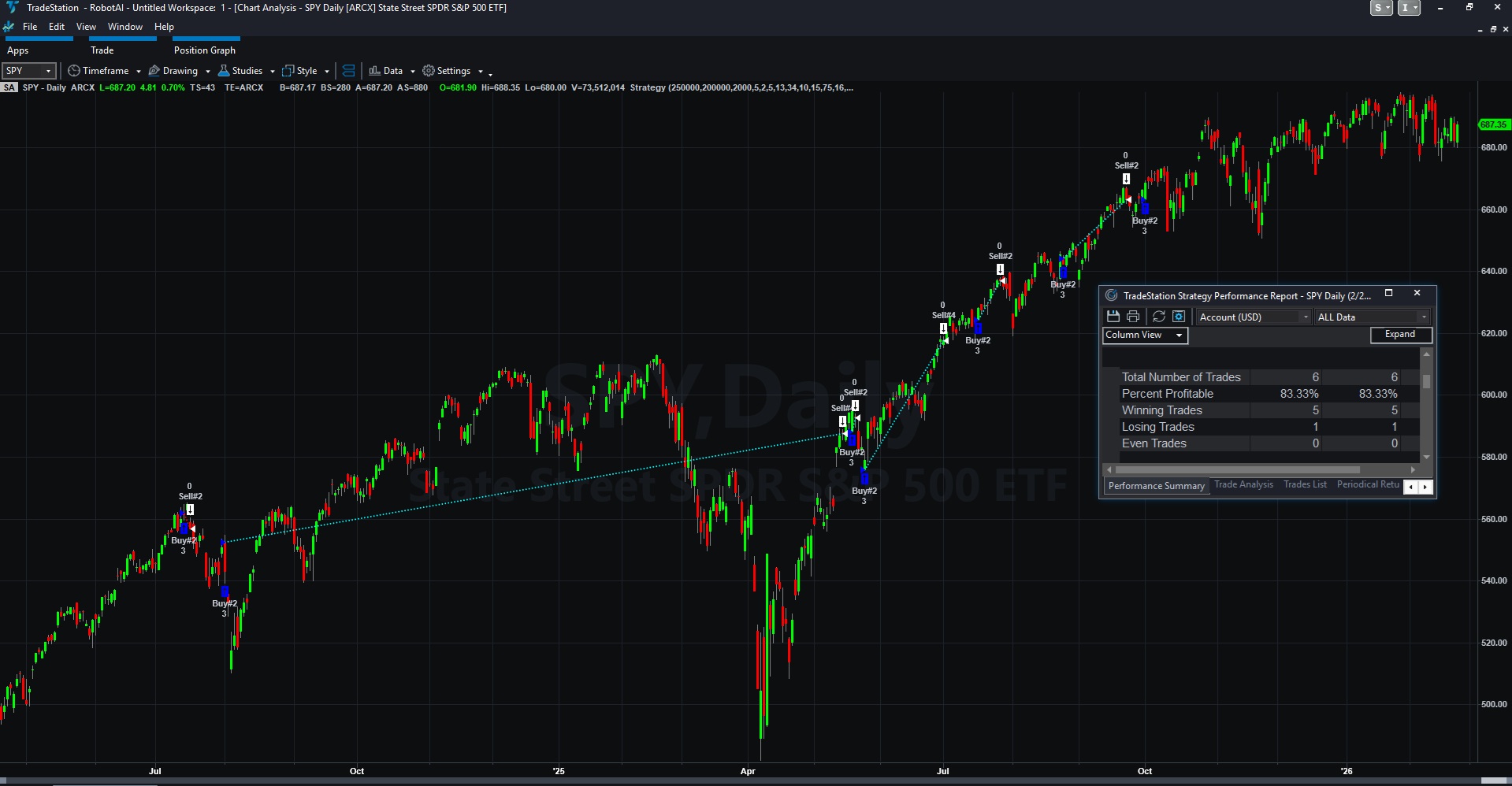
TradeExecutor.AI exemplifies this approach on TradeStation. When energy volatility spikes and the S&P 500 hits new highs simultaneously, the system doesn't experience confusion or conflicting emotions. It processes current market data through established logic and executes accordingly.
The deterministic nature eliminates human failure points. Same inputs produce same outputs, whether markets are calm or chaotic. A stop loss at $45.50 triggers at $45.50, not at $45.30 because the trader hesitated, or at $46.00 because they hoped for a bounce.
This consistency compounds over time. Small execution improvements across hundreds of trades create meaningful performance differences. A discretionary trader might execute their intended strategy correctly 70% of the time. An automated system executes correctly 100% of the time, every time.
What Is an Execution Leak in Trading?
An execution leak is the performance difference between a strategy's backtested results and actual trading results, typically caused by emotional decision-making and timing errors. These leaks drain profits through seemingly minor modifications that accumulate over time.
Every time a trader sees Apple jumping 4% and thinks "maybe I should add more tech exposure," they create potential execution leak. The original strategy didn't account for real-time sector rotation decisions. Adding discretionary elements introduces variables that weren't backtested.
Execution leaks appear in multiple forms: delayed entries due to hesitation, early exits due to fear, oversized positions due to overconfidence, and undersized positions due to recent losses. Each modification feels justified in the moment but moves actual results away from tested expectations.
Professional trading firms spend millions minimizing execution leaks through technology and process improvements. Individual traders often ignore this concept entirely, focusing on finding better strategies instead of better execution of existing strategies.
TradeExecutor.AI addresses this problem directly by removing human decision points between signal generation and trade execution. The strategy runs identically whether oil crashes or soars, whether the S&P 500 hits records or corrections.
Why Do Tested Strategies Outperform Market Timing?
Tested strategies outperform market timing because they're built on statistical edges rather than predictive abilities, and they maintain consistency through all market conditions. Market timing requires being right about direction and timing repeatedly — a nearly impossible standard.
Today's market action illustrates this perfectly. Energy down, tech up, S&P 500 at records — did you predict this exact combination? More importantly, will you correctly predict tomorrow's variation? Market timing demands continuous accuracy about unpredictable events.
Rules-based strategies don't predict. They respond to quantifiable patterns that have demonstrated statistical edges over time. When backtested across multiple market environments, these edges persist because they're based on behavioral and structural market characteristics, not predictive accuracy.
The transparency element matters here. Every TradeExecutor.AI trade result can be verified against the programmed logic. No "I thought the market would..." explanations. No post-hoc justifications. Results match rules, consistently and measurably.
Does One Platform Make a Difference?
Yes, using one platform eliminates technical execution risks and ensures consistent trade execution across all market conditions. Multiple platforms introduce latency differences, data feed variations, and connectivity issues that compound during volatile periods.
TradeStation provides institutional-grade execution infrastructure that handles today's energy volatility and record S&P 500 levels without system strain. Orders execute at intended prices. Data feeds remain consistent. The automated strategy operates without platform-related interference.
Platform consistency becomes crucial during volatile periods when every millisecond matters. A rules-based system executing on TradeStation doesn't experience the technical delays or data discrepancies that plague multi-platform approaches. The strategy operates in its intended environment, producing intended results.
This focus on one platform, one strategy, and one-time payment eliminates variables that discretionary traders often overlook. Technology becomes an advantage rather than a complication.
The market will continue delivering volatile days like today. Energy will swing. Records will be set and broken. The question remains: will your execution follow rules or emotions?
TradeExecutor.AI removes that choice entirely, executing your strategy exactly as designed, regardless of headlines or market drama.
Tested. Trusted. Transparent.How much is your execution leak costing you?
Most traders lose more to overrides than to bad strategy. Calculate yours in 30 seconds.
Calculate Your LeakTradeExecutor.ai — deterministic automated execution engine
← Back to Insights