When Markets Panic, Does Your Strategy Follow Rules or Headlines?
The Dow plunged 400 points today. Tech stocks cratered 2.5%. Oil futures whipsawed after Trump's Iran deal comments sent energy traders scrambling for exits. Right now, discretionary traders are staring at screens, second-guessing every signal, and letting headlines drive decisions that should be driven by data.
TL;DR: Market volatility exposes the fatal flaw in discretionary trading — emotion overrides strategy when you need discipline most. Rules-based execution systems execute the same way whether oil drops 5% or headlines scream panic, removing the human failure point between signal and action.Today's selloff perfectly illustrates why rules-based strategy execution matters more than the strategy itself. The best trading plan in the world fails the moment human emotion enters the execution chain.
The community submitted 1 prediction for AAPL. Every week, the most popular symbol gets publicly reviewed — good or bad.
Submit a Symbol →What Happens When Discretionary Traders See Headlines?
Discretionary traders abandon their plans the moment volatility spikes above comfort levels. A trader with a solid energy sector strategy sees "Iran deal in two days" and immediately starts questioning every position, every signal, every rule they spent months developing.
The pattern repeats every time: Headlines hit. Traders panic. Rules get thrown out. Losses mount. The strategy gets blamed, but the strategy never changed — the execution did. Discretionary trading introduces a variable that backtests can't account for: human psychology under pressure.
Meanwhile, automated systems execute the same way whether the VIX is at 12 or 42. No headlines. No second-guessing. No 3 AM position adjustments because a Tweet moved crude oil futures.
"Down $200 on a day trade. Not much. But I refused to take it. 'It's only $200, it'll come back.' $200 became $400. Then $700. Then $1,200. I finally sold. Six hours of holding. Six hours of hoping...."
Should You Change Your Strategy When Oil Crashes?
No. Strategy changes should be based on statistical evidence, not single-day price movements or geopolitical speculation. Oil crashed today because of potential policy changes, not because energy trading strategies suddenly stopped working.
The urge to "adapt" during volatility is exactly when traders destroy months of disciplined execution. A rules-based approach treats today's oil crash like any other price movement — another data point to process according to predetermined parameters.
Consider this: If your strategy couldn't handle oil moving 5% overnight, it was never a viable strategy. If it can handle that volatility, then today's headlines change nothing about execution requirements.
What Is an Execution Leak in Trading?
Execution leaks occur when actual trades deviate from planned trades due to human interference. Every time you hesitate on a signal, exit early due to news, or skip a trade because "the market feels different," you create an execution leak that degrades strategy performance.
Research shows discretionary traders typically capture only 60-70% of their strategy's backtested returns due to execution leaks. The gap between theoretical performance and actual results isn't just slippage and commissions — it's human psychology systematically undermining rule-based decisions.
Today's market action creates massive execution leaks. Traders see tech stocks down 2.5% and suddenly their small-cap growth signals "feel risky." Energy traders read about Iran deals and start second-guessing oil sector positions. Each deviation compounds, turning winning strategies into losing accounts.
Our execution leak calculator quantifies exactly how much these psychological overrides cost over time. Most traders are shocked by the actual numbers.
How Does Automated Trading Handle Market Selloffs?
Automated trading systems process today's 400-point Dow drop as raw price data, not emotional triggers. The system receives the same inputs it always receives — price, volume, technical indicators — and produces the same outputs it always produces according to predetermined rules.
No system sits out trades because "the market feels unstable." No algorithm reads Trump's Iran comments and decides energy signals need human judgment. The rules execute identically whether markets rise 2% or fall 2%.
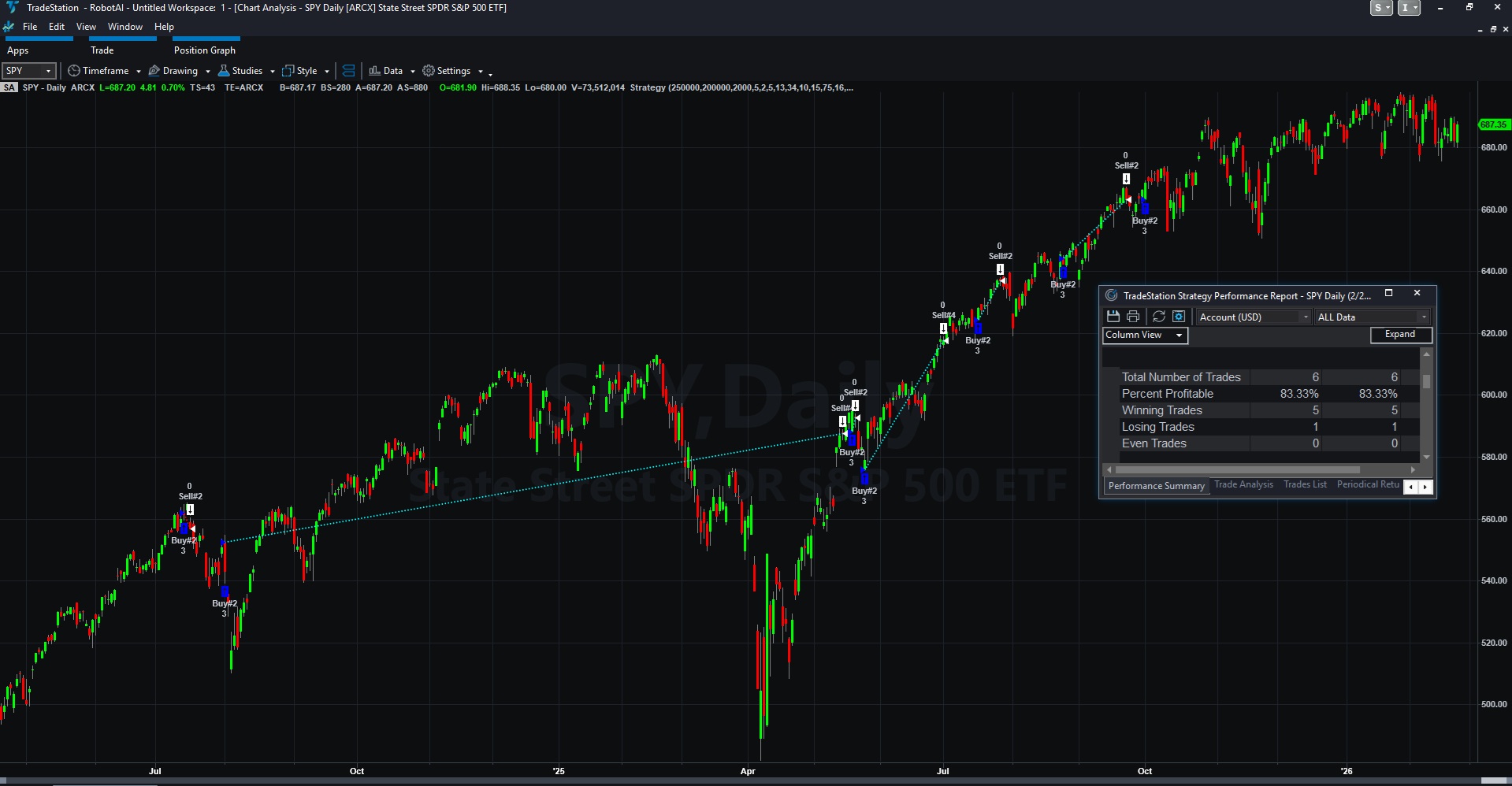
TradeExecutor.AI exemplifies this approach: one strategy, executed consistently on TradeStation, with no discretionary overrides permitted. The system that ran during calm markets in July runs identically during today's volatility. Same inputs, same logic, same execution speed.
This consistency is exactly what discretionary traders lose during high-volatility periods. When emotional pressure peaks, human judgment becomes least reliable, but automated systems maintain identical decision-making processes.
Why Does Rules-Based Execution Matter More During Volatility?
Rules-based execution becomes most valuable precisely when following rules feels most uncomfortable. Today's market action triggers every psychological bias that destroys trading performance: loss aversion, recency bias, confirmation bias, and panic-driven decision making.
A discretionary trader watching tech stocks crater starts cherry-picking which signals to follow based on "market conditions" — a euphemism for emotional comfort level. Meanwhile, rules-based systems execute every qualifying signal with identical precision, whether markets are calm or chaotic.
The mathematical reality is straightforward: If your strategy works over hundreds of trades, individual trade outcomes — even during volatile days like today — are statistically meaningless. Rules-based execution maintains this long-term perspective when human psychology focuses obsessively on short-term noise.
Does One Bad Day Invalidate Your Trading Strategy?
Absolutely not. Strategy validation requires hundreds of trades across multiple market conditions, not single-day performance during headline-driven volatility. Today's selloff provides exactly the type of stress-test that separates robust strategies from curve-fitted systems.
The question isn't whether your strategy performed well today — it's whether you executed your strategy consistently today. Most discretionary traders failed this test before markets even opened, letting overnight futures action and morning headlines influence their execution decisions.
TradeExecutor.AI removes this human variable entirely. The strategy either works over statistically significant sample sizes, or it doesn't. Individual trading sessions — regardless of headline drama — don't change mathematical probabilities or alter execution protocols.
The Real Cost of Emotional Override
Every time you override your rules because "this time is different," you're essentially claiming to have information that wasn't available when you developed those rules. Today's Iran headlines might feel significant, but they're just another geopolitical event in a long series of events your strategy should already account for.
The mathematical cost compounds quickly. Override 20% of your signals during "uncertain" periods, and you're essentially running a different strategy than the one you backtested. The performance data you relied on no longer applies to your actual trading approach.
Rules-based execution eliminates this degradation entirely. Every signal gets treated identically, whether it occurs during quiet Tuesday morning sessions or during headline-driven selloffs like today. The strategy you tested is the strategy you trade.
This consistency is why TradeExecutor.AI focuses on single-strategy execution rather than multiple approaches or discretionary flexibility. One strategy, tested thoroughly, executed consistently, produces deterministic results over time.
Ready to eliminate execution leaks from your trading? Calculate exactly how much emotional overrides are costing your strategy, or explore how rules-based automation handles volatility without human interference.
Tested. Trusted. Transparent.How much is your execution leak costing you?
Most traders lose more to overrides than to bad strategy. Calculate yours in 30 seconds.
Calculate Your LeakTradeExecutor.ai — deterministic automated execution engine
← Back to Insights