The Dow Hits 50K as AI Trade Roars Back: Does Your Strategy Follow Rules or Hype?
The Dow just retook the 50,000 level while the S&P 500 and Nasdaq surge on renewed AI optimism. Headlines scream about the "AI trade roaring back" as algorithms supposedly drive massive market moves. But here's what the excitement misses: the real power of AI in trading isn't in predicting the next hot sector—it's in executing the same proven strategy without the emotional interference that destroys returns.
TL;DR: Market hype creates execution chaos. Rules-based trading systems execute predetermined strategies consistently, regardless of whether AI stocks surge or crash. The difference between following rules and chasing headlines often determines whether traders profit from volatility or become victims of it.The frenzy around today's AI-driven rally reveals everything wrong with discretionary trading. While retail traders scramble to chase momentum and institutional managers justify position changes with fresh narratives, systematic traders using a proven rules-based strategy continue executing predetermined signals without deviation.
The community submitted 1 prediction for AAPL. Every week, the most popular symbol gets publicly reviewed — good or bad.
Submit a Symbol →What Happens When Discretionary Traders See "AI Trade Roars Back" Headlines?
Discretionary traders react predictably to momentum headlines: they abandon their original plan. A trader who spent weeks analyzing energy stocks suddenly pivots to chase AI names because CNBC says the sector is "roaring back." They increase position sizes beyond risk parameters, convinced this time is different.
The execution leak starts immediately. Instead of following entry rules at predetermined price levels, they market-buy into the surge. They skip stop-losses because "the trend is so strong." They hold winners too long when momentum shifts and cut losers too early when drawdowns begin.
This behavior isn't weakness—it's human nature responding to incomplete information. The same cognitive biases that help humans navigate complex social situations destroy trading performance when applied to market execution.
"Down $200 on a day trade. Not much. But I refused to take it. 'It's only $200, it'll come back.' $200 became $400. Then $700. Then $1,200. I finally sold. Six hours of holding. Six hours of hoping...."
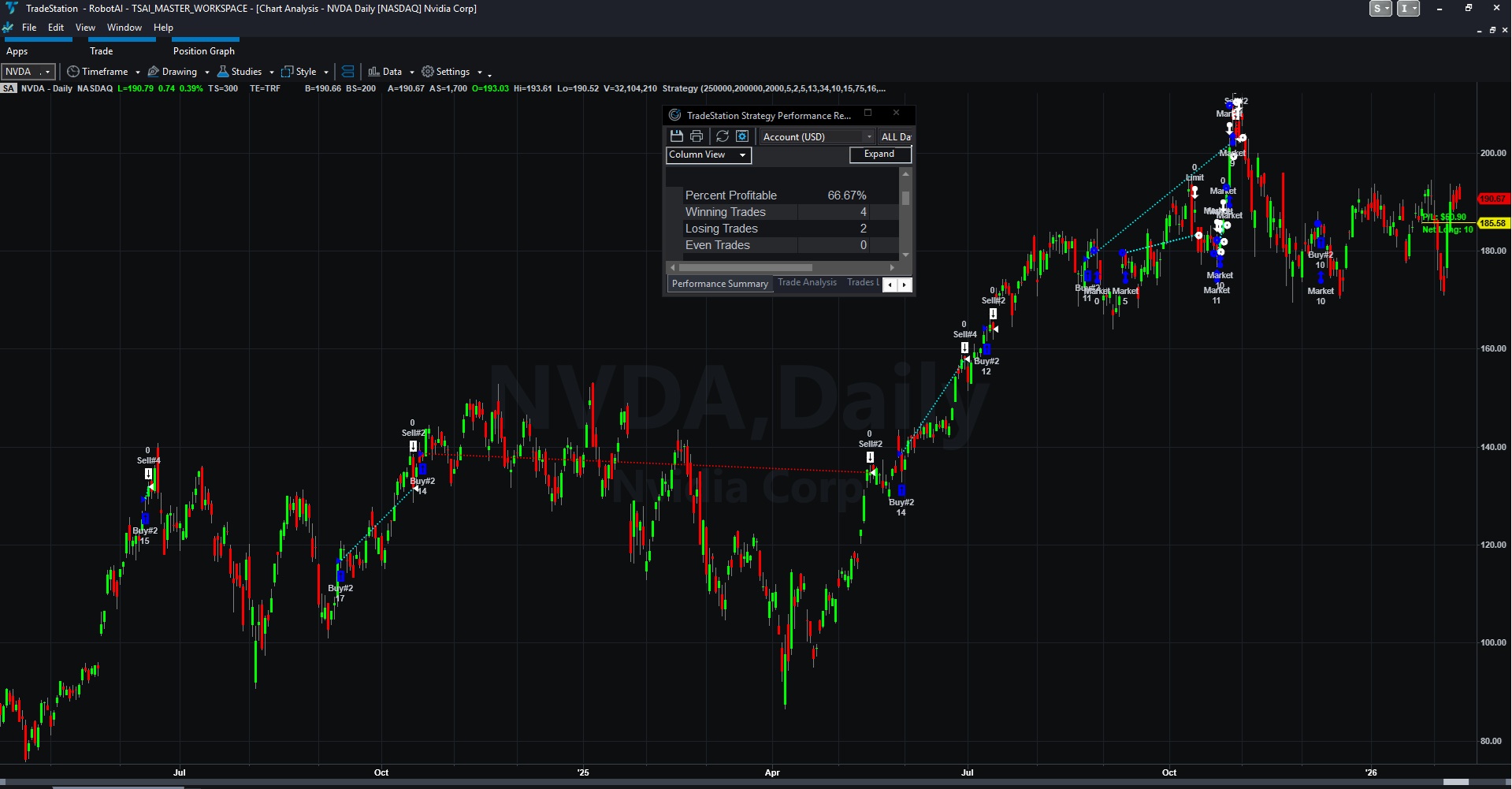
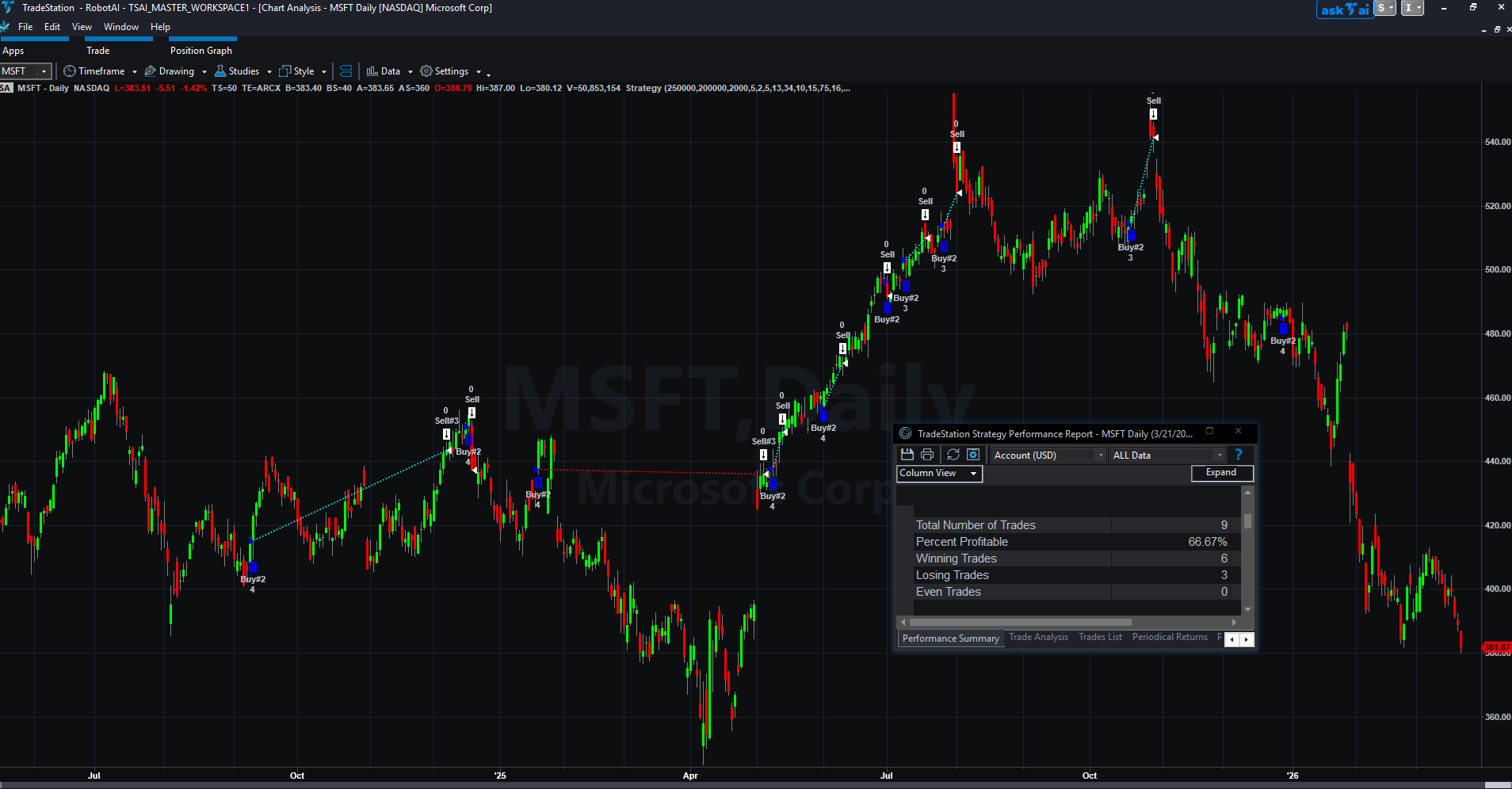
How Does Automated Trading Handle AI Stock Surges?
Automated trading systems ignore headlines entirely and execute based on predetermined technical or fundamental criteria. When AI stocks surge, the system checks current positions against strategy rules: Is there a valid entry signal? Does position sizing align with risk parameters? Have exit conditions been triggered?
A rules-based system doesn't care whether the Dow hits 50,000 or 40,000. It processes the same inputs—price action, volume, volatility measures—and produces identical outputs based on backtested parameters. If the strategy calls for entering a position at a specific technical level, the system executes at that level regardless of surrounding market narrative.
TradeExecutor.AI exemplifies this approach by removing human interpretation from the execution chain. The system receives signals from a tested strategy and executes trades on TradeStation without discretionary overrides. No "this time is different" adjustments. No position size increases because of compelling headlines.
Should You Override Your System When Markets Hit New Highs?
Never override a systematically tested strategy based on market headlines or emotional conviction. Overrides represent the exact human failure point that systematic trading eliminates. Every override assumes the trader possesses superior information to the backtested strategy—an assumption that data consistently disproves.
Consider what happens during today's rally. A discretionary trader sees AI stocks surging and thinks: "My system wants me to sell here, but clearly the trend is accelerating. I should hold longer." That single decision introduces unlimited downside risk that wasn't present in the original strategy.
The mathematics are unforgiving. A strategy backtested over thousands of trades incorporates hundreds of similar scenarios—markets hitting new highs, sectors rotating in and out of favor, momentum accelerating beyond expectations. The system's response to these conditions is already embedded in the rules.
14 levels from Gut to Executor. We don't expect anyone to blindly jump in — do your due diligence. Submit symbols, track your predictions, and prove your discipline.
 Start Your Path →
What Is an Execution Leak in Trading?
Execution leak represents the performance gap between a strategy's theoretical returns and actual trader results. This gap emerges from slippage, timing delays, emotional decisions, and discretionary overrides that deviate from the original system.
The leak compounds over time. A trader who consistently enters positions 1% above optimal levels, holds losers 10% longer than rules dictate, and cuts winners 15% early creates systematic underperformance that destroys long-term returns. These seemingly small deviations accumulate into significant portfolio damage.
Execution leak explains why published strategy results rarely translate to trader accounts. The strategy itself may be profitable, but human implementation introduces enough friction to eliminate the edge. Professional traders estimate execution leak accounts for 20-40% of retail trader underperformance.
How Do Rules-Based Systems Handle Market Volatility?
Rules-based systems treat volatility as input data rather than emotional trigger. When the VIX spikes or markets gap overnight, the system adjusts position sizing, stop-loss levels, and entry criteria according to predetermined volatility parameters—not human panic responses.
Volatility often creates the best trading opportunities because it generates larger price movements that systematic strategies can capture. But only if execution remains consistent. A trader who reduces position sizes during volatility from fear, or increases them from greed, fails to capture the mathematical edge that volatility provides.
TradeExecutor.AI processes volatility through quantified rules embedded in its strategy framework. High volatility might trigger wider stops or smaller position sizes, but these adjustments follow tested parameters rather than real-time emotional reactions. The system maintains identical execution discipline whether markets move 0.5% or 5% in a session.
Why One Strategy, One Platform Matters for Consistency
Strategy proliferation dilutes execution quality and creates decision fatigue. Traders who run multiple strategies across different platforms constantly face choices: Which signal to follow? How to allocate capital? When to override one system for another?
Each additional strategy introduces new execution leak opportunities. Complex multi-strategy portfolios require constant parameter adjustments, correlation monitoring, and risk rebalancing—all manual processes that human traders execute imperfectly under pressure.
The TradeExecutor approach eliminates this complexity through focused execution: one thoroughly tested strategy on TradeStation's reliable infrastructure. This constraint forces depth over breadth, ensuring every aspect of execution is optimized rather than spreading attention across multiple imperfectly implemented approaches.
Does Market Timing Work Better Than Systematic Execution?
Market timing consistently underperforms systematic execution because it requires predicting market direction rather than following price action. Today's AI rally demonstrates the timing challenge: Was the optimal entry yesterday before the surge, this morning at the open, or now during the momentum?
Systematic strategies sidestep timing decisions by following predetermined triggers. Instead of predicting whether AI stocks will continue rallying, the system waits for specific technical or fundamental conditions that historically preceded profitable trades. Entry timing becomes mechanical rather than predictive.
The data strongly favors systematic approaches. Academic research shows that over 80% of active fund managers underperform index benchmarks over 10-year periods, largely due to timing and selection errors that systematic strategies avoid through rule-based discipline.
The Dow's 50,000 milestone and today's AI surge represent market noise that systematic traders filter through proven frameworks. While discretionary traders debate whether this rally has "legs" or represents a "buying opportunity," rules-based systems continue executing the same disciplined approach that generated profits during previous rallies, corrections, and sideways markets.
The choice is clear: follow rules or follow hype. One approach builds wealth systematically. The other creates exciting stories and mediocre returns.
Tested. Trusted. Transparent.How much is your execution leak costing you?
Most traders lose more to overrides than to bad strategy. Calculate yours in 30 seconds.
Calculate Your LeakTradeExecutor.ai — deterministic automated execution engine
← Back to Insights