When the Dow Drops 400 Points: Why Rules Beat Gut Reactions
The Dow just plunged 400 points as oil prices and bond yields climbed higher. Somewhere right now, a trader is staring at red screens, finger hovering over the sell button, wondering if they should dump their energy positions or double down. That moment of hesitation? That's where fortunes are lost.
TL;DR: Rules-based execution systems follow predetermined logic regardless of market chaos, while discretionary traders make emotional decisions during volatility. When oil moves 5% overnight and markets crash, automated systems execute the same strategy that was backtested over thousands of similar scenarios — no panic, no overrides, no execution leaks.Today's market turmoil exposes the fundamental weakness in discretionary trading: humans make different decisions under stress than they do in calm conditions. Your rules-based strategy doesn't care if oil hits $90 or $60. It doesn't read headlines about bond yields. It simply executes the same logic, trade after trade, exactly as programmed.
The community submitted 1 prediction for AAPL. Every week, the most popular symbol gets publicly reviewed — good or bad.
Submit a Symbol →Does Your Strategy Follow Rules or Hype?
A true strategy operates independently of current market sentiment or breaking news. If your trading decisions change based on CNBC headlines or overnight oil price moves, you're not following a strategy — you're reacting to noise.
Rules-based execution removes the human interpretation layer that corrupts strategy implementation. When the Dow drops 400 points, a rules-based system checks its predefined conditions: Are the entry signals met? Are position size limits respected? Are stop losses triggered? The system doesn't factor in fear, hope, or the urge to "wait and see what happens."
Discretionary traders, meanwhile, start second-guessing their plan the moment volatility spikes. They see oil climbing and think "Maybe I should exit my energy shorts early." They watch bond yields rise and wonder "Should I hedge my long positions?" These aren't strategy modifications — they're strategy abandonment.
"Down $200 on a day trade. Not much. But I refused to take it. 'It's only $200, it'll come back.' $200 became $400. Then $700. Then $1,200. I finally sold. Six hours of holding. Six hours of hoping...."
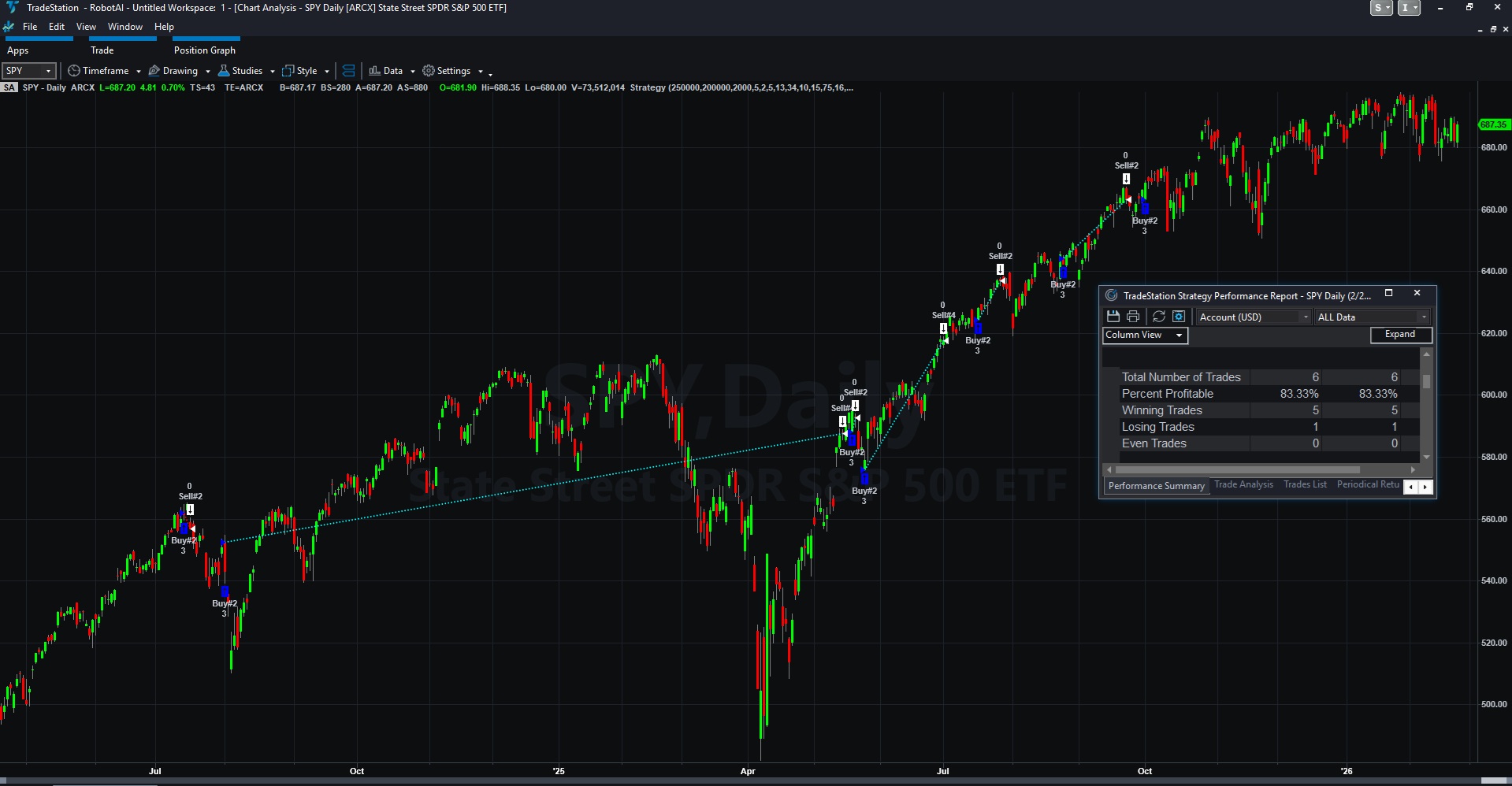
What Happens When Discretionary Traders See Red Screens?
Discretionary traders typically make three fatal errors during market stress. First, they freeze during critical execution moments, watching profitable setups turn into losses while they debate whether conditions have "changed." Second, they override their original plan based on real-time emotions, exiting winning trades too early or holding losing positions too long. Third, they change their strategy mid-stream, abandoning tested approaches for untested reactions to current events.
Consider today's scenario: oil prices surge overnight, bond yields climb, and futures open deep red. A discretionary trader with long positions might panic-sell at the open, booking unnecessary losses before the market finds its footing. Another might ignore their stop losses, hoping the selloff is temporary. Both decisions stem from the same problem: human judgment corrupted by stress.
The execution leak — the gap between strategy intent and actual performance — widens dramatically during volatile periods. A strategy that returns 15% annually in backtesting might deliver only 8% when executed by emotional humans making real-time adjustments.
How Does Automated Trading Handle Volatility?
Automated trading systems execute identical logic whether markets move 0.1% or 4% in a session. TradeExecutor.AI processes the same entry conditions, position sizing rules, and exit criteria regardless of external market stress or media commentary about oil prices and bond yields.
When oil prices spike 5% overnight, an automated system doesn't interpret this as bullish or bearish — it simply processes current price action against its programmed parameters. If the system trades energy stocks, it follows its predetermined rules for volatility-based position sizing. If it trades broad market indices, it ignores sector-specific noise that doesn't affect its core signals.
The key advantage lies in consistency of execution. Human traders make different decisions at 2 AM when oil futures are crashing than they do at 9:30 AM when markets open. Automated systems make identical decisions regardless of time, volatility, or external market pressures.
Should You Change Your Strategy When Oil Crashes?
Strategy modification should never occur in real-time based on current market conditions. Valid strategy changes emerge from systematic analysis of performance data over complete market cycles, not from reactions to individual volatile sessions or commodity price moves.
If your energy sector strategy consistently fails during oil price shocks, that's a backtesting problem, not a real-time adjustment opportunity. The time to account for oil volatility was during strategy development, not during today's 400-point Dow drop.
Rules-based systems prevent this common error by removing the ability to make emotional overrides. When TradeExecutor.AI encounters high volatility, it follows the same tested logic that guided every trade in its development phase. The system doesn't distinguish between "normal" trading days and "crisis" trading days — it simply executes its programmed rules with identical precision.
What Is an Execution Leak in Trading?
An execution leak represents the performance gap between theoretical strategy returns and actual trading results. Execution leaks occur when traders deviate from their original plan due to fear, greed, or changing market conditions.
During today's market stress, execution leaks compound rapidly. A trader might exit a position 2% before their planned stop loss, triggered by falling oil prices. Another might reduce position sizes mid-trade, spooked by rising bond yields. Each deviation creates a small leak that accumulates into significant underperformance over time.
Research shows that execution leaks can reduce strategy performance by 20-40% annually. A strategy generating 12% returns in backtesting might deliver only 7-8% when executed by emotional humans making real-time adjustments based on market conditions.
Rules-based execution eliminates execution leaks entirely. Every trade executes exactly as programmed, with identical position sizes, entry prices, and exit criteria. The strategy performance you see in backtesting becomes the strategy performance you achieve in live trading.
Why One Strategy, One Platform, One Payment Works
Complex multi-strategy approaches fail during market stress because traders can't simultaneously track multiple rule sets while markets crash. TradeExecutor.AI's focus on one thoroughly tested strategy eliminates decision paralysis during volatile periods.
When oil prices spike and bond yields climb, you don't need to choose between momentum, mean reversion, and breakout strategies. You don't need to decide which timeframe to prioritize or which asset class to emphasize. The single strategy handles all market conditions using the same tested framework.
TradeStation integration ensures execution speed and reliability during high-volume periods when manual entry becomes impossible. The one-time payment structure removes ongoing fee pressure that might tempt traders to override the system during drawdown periods to "save money."
This focused approach proves most valuable during market stress. While discretionary traders juggle multiple competing strategies and second-guess every decision, rules-based execution maintains consistent performance through the same systematic approach that generated its backtested results.
Markets will continue delivering 400-point swings, oil price shocks, and bond yield surprises. Your execution method determines whether these events create opportunities or disasters. Rules-based systems treat every market condition as simply another data point to process through tested logic.
Tested. Trusted. Transparent.
How much is your execution leak costing you?
Most traders lose more to overrides than to bad strategy. Calculate yours in 30 seconds.
Calculate Your LeakTradeExecutor.ai — deterministic automated execution engine
← Back to Insights