Why S&P 500 Records Don't Change the Rules (Even When Everyone Else Panics)
The S&P 500 hit another record high today, with Nvidia leading the charge as chip stocks soared. CNBC's live updates tracked every uptick, every analyst upgrade, every breathless moment of momentum. Meanwhile, somewhere in America, a trader is staring at their screen wondering: "Should I chase this move? Should I change my position size? Should I override my system?"
TL;DR: Bull markets make discretionary trading feel brilliant until they don't. A rules-based strategy executes the same signals whether the S&P 500 hits records or crashes 20%. The strategy doesn't care about headlines — and that's exactly why it works when human emotions fail.The community submitted 1 prediction for AAPL. Every week, the most popular symbol gets publicly reviewed — good or bad.
Submit a Symbol →Does Market Euphoria Change Your Trading Rules?
Market euphoria shouldn't change trading rules, but it destroys most traders' discipline within days. When the S&P 500 hits fresh records and Nvidia rockets higher, discretionary traders abandon their predetermined position sizes, entry criteria, and exit rules. They increase risk because "this time feels different."
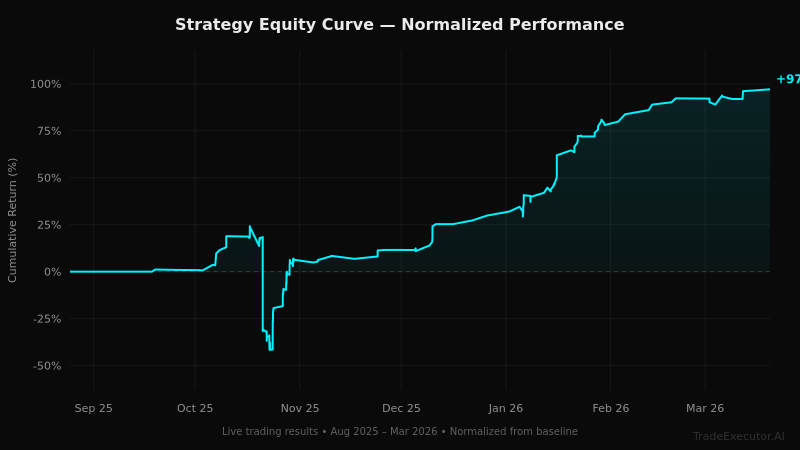
Rules-based execution systems ignore euphoria completely. The system that bought on a specific technical setup last Tuesday executes the exact same logic today, regardless of record highs or analyst upgrades. No position size increases. No rule modifications. No "riding the winner a little longer" decisions that typically precede the biggest losses.
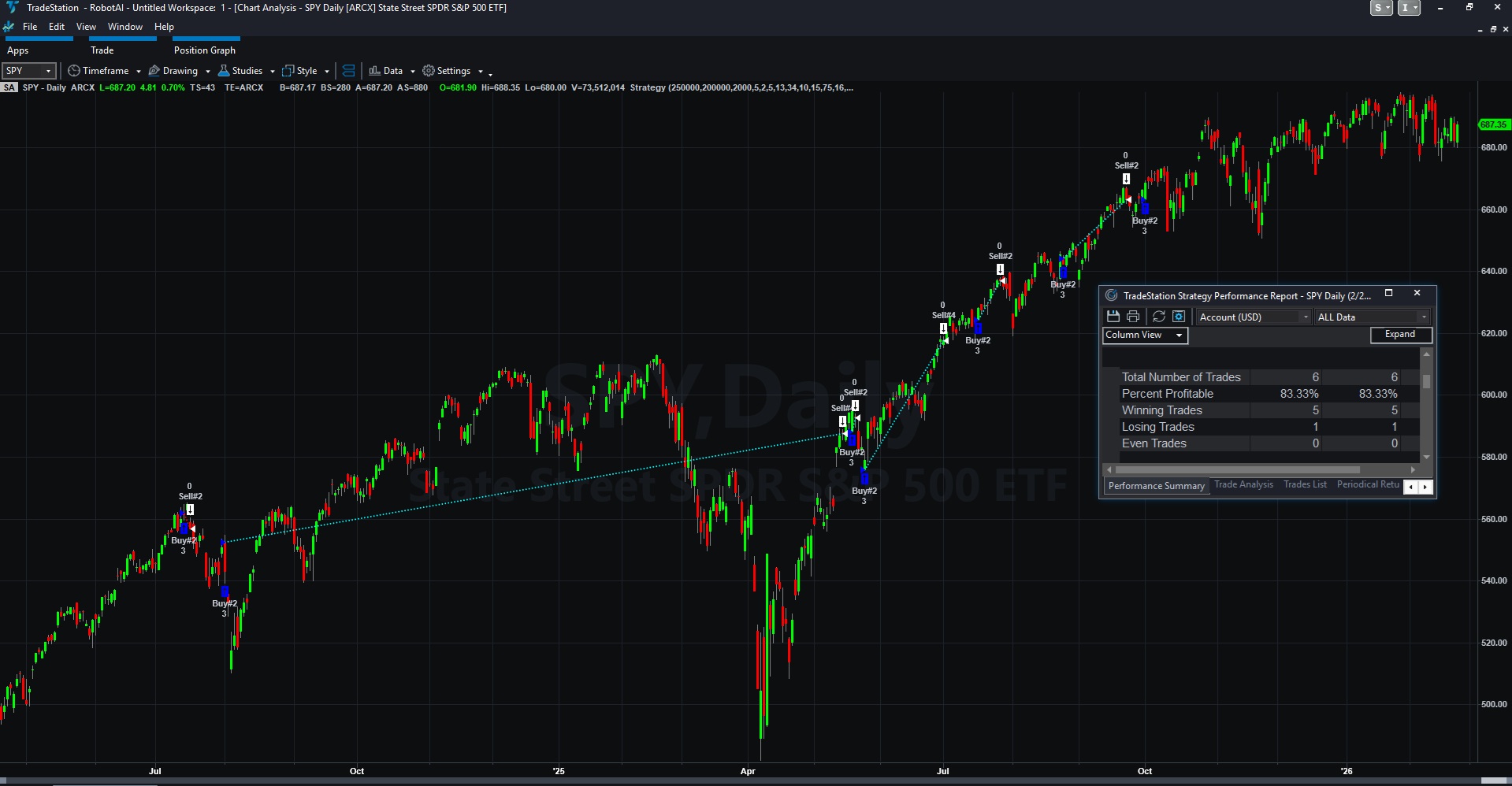
TradeExecutor.AI processes the same entry signals, position sizing formulas, and exit criteria whether markets gap up 2% or crash 5%. The algorithm doesn't read CNBC headlines or feel the intoxicating pull of momentum. It simply executes predetermined rules without deviation.
Consider two traders with identical strategies on paper. Trader A uses discretionary execution and increases position sizes during this Nvidia-led rally because "the trend is clearly accelerating." Trader B runs the identical strategy through automated execution, maintaining consistent position sizing regardless of recent performance. Six months from now, their results will differ dramatically — not because of strategy differences, but because of execution differences.
"Down $200 on a day trade. Not much. But I refused to take it. 'It's only $200, it'll come back.' $200 became $400. Then $700. Then $1,200. I finally sold. Six hours of holding. Six hours of hoping...."
How Does Automated Trading Handle Record Highs?
Automated trading handles record highs by treating them as ordinary price data points within predefined parameters. The system evaluates current price action against historical patterns, volatility measurements, and technical indicators without emotional bias toward "record high" labels.
When the S&P 500 scales new peaks, automated systems execute based on mathematical relationships, not psychological reactions. If the rules say "exit 50% of position when RSI exceeds 80," the system exits exactly 50% — not 30% because "the momentum looks unstoppable" or 70% because "records usually mean a pullback is coming."
This mechanical approach eliminates what traders call "execution leak" — the performance gap between a strategy's theoretical returns and actual trading results. Execution leak typically widens during extreme market conditions when emotions run hottest. Record highs trigger greed; sudden drops trigger fear. Both emotions corrupt execution.
A rules-based system processes today's Nvidia surge identically to any other price movement meeting its criteria. No excitement about chip sector rotation. No speculation about AI bubble dynamics. No position modifications based on sector headlines. The system's response depends entirely on price, volume, and technical indicators — the same inputs it uses every trading day.
Human traders consistently underperform their own strategies during record-setting market moves because they second-guess their rules when they matter most. Automated execution removes this failure point by making human override impossible.
What Happens When Bull Market Euphoria Ends?
Bull market euphoria ends with traders who abandoned their rules facing catastrophic losses, while systematic traders continue executing their predetermined strategies. The same discretionary decisions that felt brilliant during record highs — increased position sizes, longer holding periods, reduced stop losses — become portfolio killers when momentum reverses.
Historical data shows that traders who modify their strategies during bull runs typically give back 60-80% of their gains during subsequent corrections. They increase risk when assets are expensive and decrease risk when assets become cheap — the exact opposite of profitable long-term trading.
Rules-based systems maintain consistent risk management throughout market cycles. The position sizing algorithm that limited exposure during record highs continues operating during inevitable pullbacks. Exit rules trigger at predetermined levels regardless of whether the trader "feels confident" about recovery prospects.
TradeExecutor.AI's systematic approach means the same risk parameters govern every trade, whether executed during euphoric bull markets or panic-driven selloffs. No human intervention means no emotional interference with proven mathematical relationships.
The traders who survive and prosper through multiple market cycles share one characteristic: they follow identical processes regardless of market conditions. They don't have "bull market rules" and "bear market rules." They have rules, period.
14 levels from Gut to Executor. We don't expect anyone to blindly jump in — do your due diligence. Submit symbols, track your predictions, and prove your discipline.
 Start Your Path →
Should You Override Your System During Market Records?
You should never override your system during market records, as this is precisely when emotional interference causes the most damage to long-term performance. Override temptation peaks during extreme market movements — both euphoric highs and panic lows — making these the worst possible times for discretionary intervention.
The psychology behind override decisions reveals why they fail consistently. During record highs, traders want to "maximize the opportunity" by increasing position sizes or holding winners longer. During crashes, they want to "protect capital" by closing positions early or skipping valid signals. Both impulses contradict the mathematical foundations that made their original strategy profitable.
Professional systematic traders understand that their edge comes from consistent execution of proven rules, not from predicting when to deviate from those rules. If they could successfully predict when to override, they would build those predictions into their systematic rules rather than relying on real-time emotional decisions.
Consider the trader watching today's chip rally who thinks: "Nvidia's momentum looks incredible — I should double my position size on the next signal." This trader has forgotten a fundamental truth: their strategy already accounts for momentum through its entry and exit rules. Position sizing exists to manage risk, not to express conviction about individual trades.
TradeExecutor.AI eliminates override temptation by removing human intervention from the execution process. The system cannot be influenced by compelling headlines, analyst upgrades, or the intoxicating feeling of watching positions move in your favor during bull runs.
Why One Strategy Beats Market Timing
One strategy beats market timing because consistent execution of proven rules outperforms sporadic attempts to predict optimal market entry and exit points. Market timing requires being correct twice — when to enter and when to exit — while systematic strategy execution requires being correct once about the underlying mathematical edge.
Today's S&P 500 record illustrates why market timing fails. Traders who waited for "a better entry point" missed months of gains. Traders who now worry about "buying the top" will likely miss future gains while waiting for corrections that may not materialize. Meanwhile, systematic traders simply execute their rules regardless of timing concerns.
The mathematics favor consistency over perfection. A strategy with 55% win rate and proper risk management generates substantial long-term profits through systematic execution. The same strategy executed sporadically through market timing attempts typically produces inferior results because human emotions corrupt the execution process.
TradeExecutor.AI focuses on one strategy, executed consistently on one platform (TradeStation), without timing considerations. The system doesn't attempt to predict optimal market entry points or rotate between strategies based on market conditions. It simply executes predetermined rules with mathematical precision.
Successful trading comes from finding an edge and executing it consistently, not from predicting market direction or timing optimal entries. The edge exists in the mathematical relationship between risk and reward, not in human ability to forecast short-term price movements.
Professional traders know that their job isn't predicting the future — it's executing proven processes regardless of what the future might bring.
Tested. Trusted. Transparent.How much is your execution leak costing you?
Most traders lose more to overrides than to bad strategy. Calculate yours in 30 seconds.
Calculate Your LeakTradeExecutor.ai — deterministic automated execution engine
← Back to Insights