How to Reduce Execution Leak in Trading: A Step-by-Step Guide
Every trader knows the feeling. Your analysis is perfect, your entry signal is clear, but somehow the trade goes sideways because you hesitated, second-guessed, or let fear override your plan. This gap between your intended trade and your actual execution is called execution leak — and it's silently draining profits from even the most sophisticated strategies.
TL;DR: Execution leak occurs when human psychology interferes with rule-based trading decisions. The solution requires measuring your current leak, identifying emotional trigger points, then implementing rules-based strategy automation that removes discretionary overrides entirely. Deterministic execution systems eliminate the human failure point between signal and action.The difference between profitable and struggling traders isn't usually strategy quality — it's execution consistency. While discretionary traders debate whether to follow their rules during volatile market conditions, automated systems simply execute. No emotion, no hesitation, no second-guessing.
The community submitted 1 prediction for AAPL. Every week, the most popular symbol gets publicly reviewed — good or bad.
Submit a Symbol →What Is Execution Leak in Trading?
Execution leak represents the measurable difference between your strategy's intended performance and its actual results due to human intervention. This leak manifests in multiple ways: skipping valid signals during drawdowns, taking partial profits too early, or holding losing positions beyond predetermined stop losses.
Professional traders typically experience 15-30% execution leak on their strategies. A system that should generate 20% annual returns might only produce 14% because the trader's psychology interferes with mechanical rule following. The leak compounds over time, creating significant performance gaps.
Most traders underestimate their execution leak because they focus on their best trades while forgetting the signals they ignored or the rules they bent. Systematic measurement reveals the true cost of discretionary overrides.
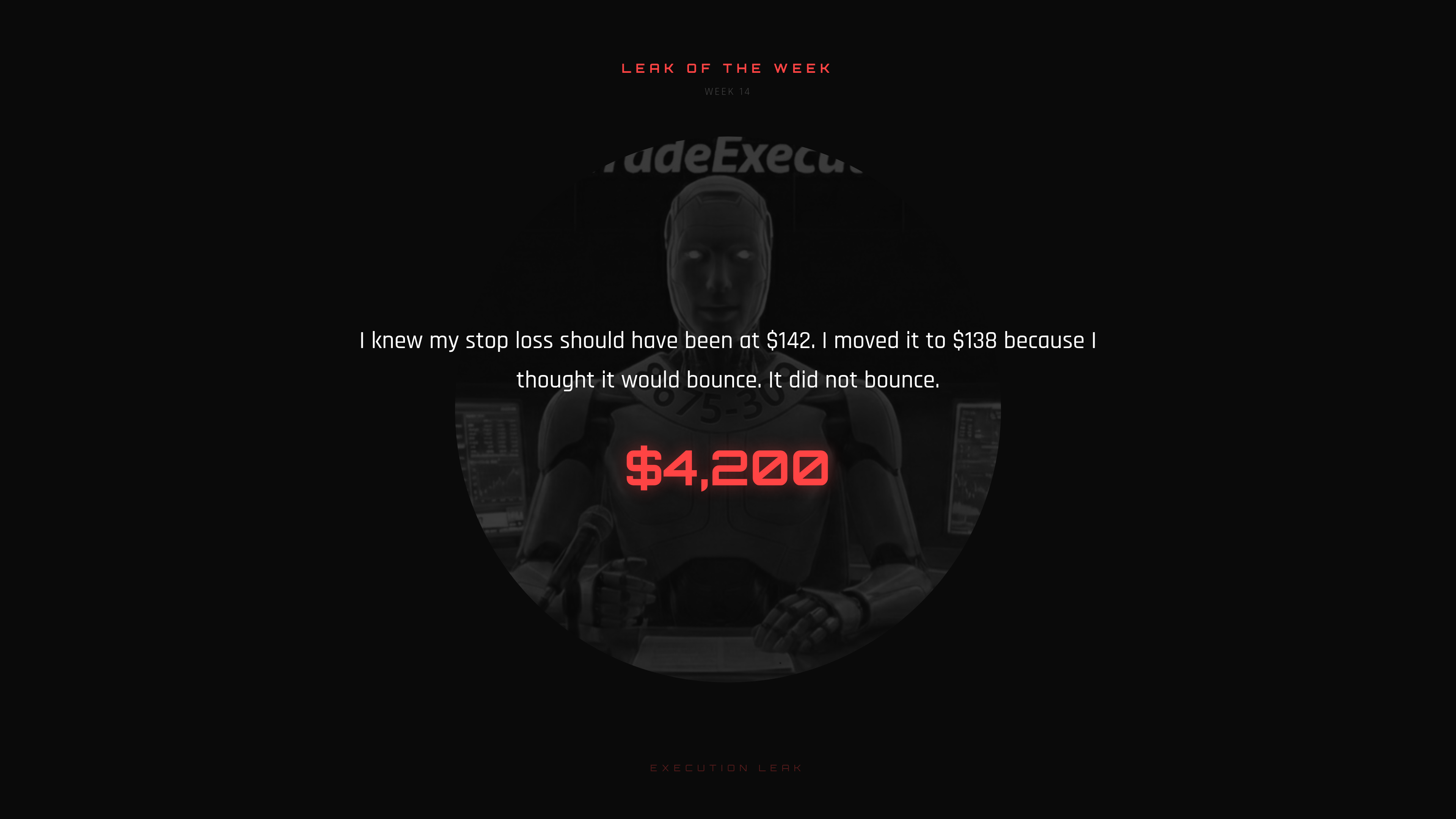
"Down $200 on a day trade. Not much. But I refused to take it. 'It's only $200, it'll come back.' $200 became $400. Then $700. Then $1,200. I finally sold. Six hours of holding. Six hours of hoping...."

How Do You Measure Your Current Execution Leak?
Start by comparing your actual trading results against your strategy's theoretical performance over the last 50 trades. Calculate three key metrics: signal compliance rate (percentage of valid signals you actually took), rule adherence rate (percentage of trades that followed all entry and exit rules), and timing accuracy (average delay between signal generation and execution).
Most traders discover they're only taking 60-70% of their valid signals, especially after consecutive losses. They also find significant timing delays during volatile periods, often missing optimal entry points by several minutes or hours. These delays directly translate to reduced profits and increased risk exposure.
Document every deviation from your rules for one month. Note whether you skipped trades, exited early, or held beyond stops. Assign dollar values to each deviation by calculating what would have happened with perfect rule adherence. The total represents your monthly execution leak.
Why Does Execution Leak Happen to Experienced Traders?
Human psychology creates predictable biases that interfere with mechanical rule following, regardless of trading experience. Loss aversion makes traders skip signals after drawdowns, even when those signals occur during optimal market conditions. Recency bias causes overweighting of recent results when evaluating current opportunities.
Successful discretionary traders often struggle more with execution leak because they've learned to analyze market context. This analytical ability becomes a liability when it encourages overriding proven rules based on "this time is different" thinking. The more sophisticated the trader, the more elaborate their justifications for rule deviations become.
Market volatility amplifies these psychological pressures. During fast-moving conditions, traders feel compelled to "help" their automated systems by making real-time adjustments. These interventions typically reduce performance because they inject emotion into previously objective decisions.
14 levels from Gut to Executor. We don't expect anyone to blindly jump in — do your due diligence. Submit symbols, track your predictions, and prove your discipline.
 Start Your Path →
Should You Trust Your Gut Over Your Trading Rules?
Never. Your gut feeling represents the same cognitive biases that create consistent losing patterns in 90% of retail traders. Rules exist precisely because emotional trading decisions, even from experienced traders, consistently underperform systematic approaches over meaningful time periods.
Professional traders understand that markets reward consistency, not cleverness. The most profitable trading operations eliminate discretionary decision-making entirely during live trading hours. They research and backtest extensively, then execute mechanically without deviation.
Your intuition developed from limited personal experience and selective memory. Your rules developed from comprehensive historical analysis and statistical validation. The choice between these two approaches should be obvious, yet most traders still trust their feelings over their data.
How Does Rules-Based Automation Eliminate Human Error?
Automated trading systems execute predetermined rules without psychological interference. When entry conditions are met, the system enters immediately. When stop losses are hit, the system exits immediately. No hesitation, no second-guessing, no emotional overrides.
TradeExecutor.AI operates on pure deterministic logic — identical market conditions always produce identical responses. The system doesn't experience fear during drawdowns or greed during winning streaks. It simply follows its programmed rules with mechanical precision across all market conditions.
This deterministic execution eliminates timing delays that plague manual trading. While human traders debate whether current market conditions justify following their rules, automated systems have already executed. The speed advantage becomes crucial during volatile periods when opportunities disappear within minutes.
What Makes TradeStation Integration Essential for Execution?
TradeStation's robust execution infrastructure ensures reliable order placement and fill rates that manual trading cannot match. The platform's direct market access reduces slippage and improves execution quality, particularly important during high-volume trading periods.
Integration with a professional-grade platform eliminates the technical failure points that affect retail trading platforms. Server uptime, connection stability, and order routing reliability become non-issues when using institutional-quality infrastructure.
TradeExecutor.AI leverages TradeStation's full capabilities through native integration, not third-party connections that introduce additional failure points. This direct integration ensures maximum reliability during critical execution moments.
How Do You Verify Your Execution System Actually Works?
Backtesting provides statistical validation of strategy performance across multiple market conditions and time periods. TradeExecutor.AI includes comprehensive backtesting data showing exact entry and exit points, drawdown periods, and performance metrics across different market environments.
Forward testing on paper trading accounts allows real-time verification without capital risk. Run your automated system parallel to your manual trading for 30-90 days, comparing results. Most traders discover their automated execution outperforms their discretionary decisions consistently.
Transparent performance reporting eliminates the selective memory issues that affect manual trading assessment. Every trade gets documented with precise entry/exit prices, timing, and reasoning. This data enables objective performance analysis impossible with discretionary trading records.
How Does TradeExecutor.AI's Pricing Work?
Trading systems that bury their real cost in bundled add-ons create ongoing pressure that encourages overtrading and excessive position sizing to justify the expense. TradeExecutor.AI takes the opposite approach: a free tier to start, then transparent, usage-tiered pricing (Monitor at $9.99/mo, Execute plans from $199/mo) that scales with the capital you're actually running.
TradeExecutor.AI's transparent, usage-tiered pricing keeps that pressure in check: the free tier costs nothing while you evaluate the system, and paid tiers scale with the capital you're executing rather than requiring you to "make the subscription pay for itself" through extra trading.
Long-term trading success requires consistent execution over multiple market cycles. TradeExecutor.AI's plan tiers are set by the capital you're executing, not by performance or market regime, so your execution system stays available exactly when consistency matters most.
What Results Can You Expect From Reducing Execution Leak?
Typical traders see 20-40% improvement in strategy performance simply by removing execution leak through automation. A strategy generating 15% annual returns might produce 18-21% returns with perfect execution — a significant improvement achieved purely through consistency.
Risk management improves dramatically because stop losses execute without hesitation or hope for reversals. Position sizing remains constant because emotional factors don't influence trade allocation. These improvements often matter more than raw return enhancement.
Sleep quality improves when you know your system handles all execution decisions mechanically. No more watching charts all day, no more debating whether to follow your rules, no more wondering if you left money on the table by missing signals.
Execution leak represents the largest controllable factor affecting trading performance. While you cannot control market movements or eliminate all risk, you can remove most of the psychological interference that prevents optimal strategy execution. Rules-based automation transforms trading from an emotional battle into a mechanical process.
TradeExecutor.AI removes human psychology from every trading decision through deterministic execution on TradeStation's professional infrastructure. One strategy, one platform, transparent pricing — consistent rules, no discretionary overrides, measurably less execution leak.
Tested. Trusted. Transparent.
How much is your execution leak costing you?
Most traders lose more to overrides than to bad strategy. Calculate yours in 30 seconds.
Calculate Your LeakTradeExecutor.ai — deterministic automated execution engine
← Back to Insights